The Kids Problem Solving Workbook: Building Smart Thinkers for a Complex World
In an era defined by information overload, rapid change, and complex global challenges, the ability to think critically and solve problems has never been more valuable. While much of the conversation around these skills centers on adult professionals and entrepreneurs, there is a growing recognition that the foundation for effective decision-making must be laid early. This is where the Kids Problem Solving Workbook enters the conversation—not merely as a collection of puzzles, but as a structured tool designed to cultivate cognitive habits that will serve children for a lifetime. For professionals, educators, and parents who understand that tomorrow's innovators are shaped by today's learning experiences, this workbook represents a meaningful shift in how we approach childhood education.
What Is the Kids Problem Solving Workbook?
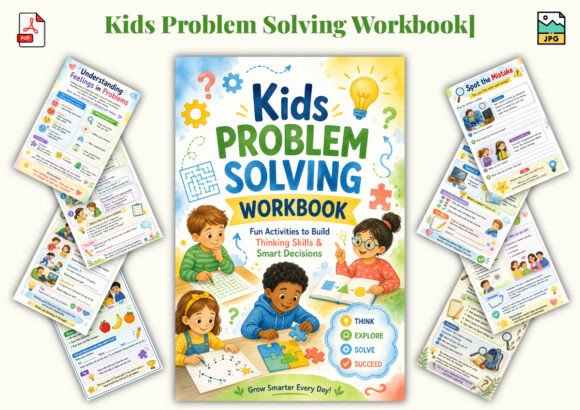
The Kids Problem Solving Workbook is a carefully designed educational resource that guides young learners through the process of identifying problems, generating multiple solutions, evaluating options, and reflecting on outcomes. It combines 44 unique activity pages with step-by-step guides, real-life scenarios, puzzles, challenges, and reflection exercises. Each page is built around a structured methodology that helps children move from impulse to analysis, from frustration to clarity, and from confusion to confident decision-making.
Unlike traditional workbooks that focus solely on academic subjects like math or reading, this workbook targets the metacognitive skills that underpin all learning. It teaches children how to think, not just what to think. This distinction is critical in a world where information is abundant but the ability to evaluate and apply it is scarce. The workbook's clean, modern layout with a soft watercolor theme makes it approachable and friendly, reducing the intimidation often associated with "thinking exercises."
Why Problem-Solving Skills Are More Important Than Ever
Professionals across industries—from product development to marketing, from entrepreneurship to creative direction—consistently report that the single most valuable skill they look for in collaborators and team members is the ability to solve problems effectively. Yet, traditional education systems often prioritize memorization and compliance over critical thinking. This gap has created a growing demand for resources that bridge the divide between what schools teach and what the world actually requires.
The Kids Problem Solving Workbook fits directly into this broader trend. Parents who work in fast-paced, innovation-driven fields are increasingly aware that their children need more than good grades to succeed. They need cognitive flexibility, resilience, and the ability to approach challenges with a structured yet creative mindset. This workbook provides exactly that—a repeatable framework that children can internalize and apply across subjects, situations, and eventually, careers.
Moreover, the rise of remote learning and hybrid educational models has placed greater responsibility on parents and caregivers to supplement formal education. Many have discovered that standard curricula do not adequately address critical thinking or decision-making. As a result, resources like this workbook are being sought not as optional enrichment but as essential components of a well-rounded education.
How the Workbook Addresses Changing Educational Needs
The educational landscape is shifting. Standardized testing is increasingly criticized for its narrow focus, and there is a growing movement toward competency-based learning, where students are assessed on their ability to apply knowledge in real-world contexts. The Kids Problem Solving Workbook aligns perfectly with this philosophy. Its exercises are not abstract—they are grounded in situations that children actually encounter, such as deciding how to share limited resources, resolving a disagreement with a friend, or choosing the best route to complete a series of errands.
These real-life scenarios make the learning tangible. When a child works through a page that asks them to identify a problem, brainstorm three possible solutions, and then choose the best one, they are practicing a skill that transfers directly to academic projects, social interactions, and eventually workplace challenges. The workbook also includes reflection exercises that encourage children to consider what they learned from mistakes—a practice that is conspicuously absent from most elementary education but is central to growth in any professional field.
For entrepreneurs and marketers who understand the value of iterative thinking, this approach will feel familiar. It mirrors the design thinking process: empathize, define, ideate, prototype, test. By introducing children to this cycle early, the workbook helps normalize the idea that failure is not an endpoint but a step in the process. This psychological shift is invaluable in a world where fear of failure often paralyzes creativity and innovation.
Why Parents, Educators, and Professionals Are Paying Attention
Several converging trends explain the growing interest in resources like the Kids Problem Solving Workbook. First, there is a heightened awareness of the importance of executive function skills—the cognitive processes that enable self-regulation, planning, and goal-directed behavior. Research over the past decade has consistently shown that executive function is a stronger predictor of long-term success than IQ or early academic achievement. Problem-solving is a core component of executive function, and this workbook directly targets it.
Second, the modern workplace increasingly values cross-disciplinary thinking. A marketer who can analyze data, craft a narrative, and adapt to changing consumer behavior is more effective than one who excels in only one domain. Similarly, a child who learns to approach a puzzle from multiple angles, test hypotheses, and revise their approach is building a mental toolkit that will serve them in any field they choose. Professionals who recognize this are seeking out tools that foster this kind of thinking in their own children or students.
Third, there is a growing rejection of passive entertainment. With screen time dominating many children's lives, parents and educators are actively looking for resources that require active engagement. The Kids Problem Solving Workbook demands participation. It asks children to write, draw, reflect, and decide. It cannot be consumed passively. For caregivers who are concerned about the effects of excessive passive media consumption, this workbook offers a welcome alternative that is both educational and enjoyable.
Practical Examples of the Workbook in Action
To understand the impact of this resource, consider a typical scenario from the workbook. A page might present a child with a situation where they have to plan a small party with a limited budget and limited time. The exercise guides them to first identify what the problem truly is—not just "I need to plan a party," but "I need to make decisions within constraints." Then, the child is prompted to list possible solutions: perhaps they could make decorations instead of buying them, or invite fewer friends, or choose a simpler menu. Next, they evaluate each option against criteria like cost, time, and enjoyment. Finally, they choose a plan and reflect on why it works.
This process may seem simple, but it teaches a structured approach that many adults have never formally learned. Entrepreneurs will recognize it as similar to the trade-off analysis they perform daily. Marketers will see it as akin to strategic campaign planning. Freelancers will find parallels to managing scope and client expectations. The workbook is effectively providing children with a simplified version of the decision-making frameworks used by professionals—and they are learning it at an age when such habits are easiest to instill.
Another example involves social problem-solving. A page might ask a child to consider what to do if they want to play with a toy that someone else is using. Instead of an impulse-driven response, the workbook encourages them to think of multiple approaches: waiting, asking nicely, suggesting a turn-based game, or finding an alternative activity. By practicing these scenarios in a low-stakes environment, children develop social fluency and emotional regulation that benefits them in school and beyond.
How This Workbook Connects to Larger Developments
The Kids Problem Solving Workbook is part of a broader movement toward intentional, skill-based early education. This movement is not confined to any single ideology or pedagogy. It draws from cognitive science, Montessori methods, project-based learning, and even insights from the business world. The common thread is a recognition that content knowledge is temporary, but thinking skills endure.
In the technology sector, there is growing discussion about the importance of "human skills" in an age of automation. As AI takes over routine tasks, the abilities that remain uniquely human—creativity, ethical reasoning, empathy, and complex problem-solving—become more valuable. By investing in a resource that builds these skills early, parents and educators are future-proofing children against a rapidly changing job market. This is not speculation; it is a logical response to observable trends in employment and skill demand.
Furthermore, the workbook aligns with the principles of growth mindset, popularized by psychologist Carol Dweck. By emphasizing that problems can be solved through effort and strategy, and that mistakes are opportunities to learn, the workbook helps children develop a view of intelligence as malleable rather than fixed. This mindset has been shown to correlate with greater resilience, higher achievement, and a more positive attitude toward challenges.
For freelancers and entrepreneurs who have built careers on adaptability and continuous learning, these concepts are second nature. The workbook provides a way to transmit these values to the next generation in a format that is concrete and actionable. It translates abstract principles like "embrace failure" and "think outside the box" into specific, age-appropriate exercises that children can practice and internalize.
Observations on Design and Engagement
The workbook's design deserves specific attention because it reflects an understanding of how children learn best. The soft watercolor theme and clean layout reduce cognitive load and create a calming atmosphere. This is not a workbook that overwhelms with cluttered graphics or chaotic instructions. Each page has a clear purpose, and the progression from simpler to more complex exercises mirrors the way skills naturally develop.
For professionals who create content or design user experiences, there are lessons here about the importance of usability and aesthetic coherence. The workbook treats the child as a capable learner rather than a passive recipient. It assumes that with the right structure and encouragement, children can engage with sophisticated ideas. This respect for the learner's potential is a hallmark of effective educational design, whether in print, digital, or classroom settings.
The inclusion of reflection and thinking exercises is another strength. These sections ask children to articulate what they learned, what they found difficult, and what they might do differently. This metacognitive practice is rare in children's resources but is well-established in adult learning theory as a driver of deep understanding. By embedding reflection directly into the workflow, the workbook ensures that learning is not just experienced but processed and retained.
Practical Considerations for Different Audiences
For educators, the Kids Problem Solving Workbook can serve as a supplement to social-emotional learning curricula, as a resource for enrichment in gifted programs, or as a tool for students who struggle with executive function. Its activities can be integrated into morning meetings, used as warm-ups for math or literacy blocks, or assigned as homework that families can complete together.
For parents who homeschool, the workbook offers a structured yet flexible way to address critical thinking without requiring extensive prep time. It can be used as a standalone subject or woven into thematic units. For parents whose children attend traditional schools, it provides a way to supplement classroom learning with skills that are often overlooked in the standard curriculum.
For professionals who are parents themselves—whether they work in marketing, technology, finance, or creative fields—the workbook offers a way to share their own thinking processes with their children in a format that is both fun and educational. It opens the door for conversations about how problems are solved at work, how decisions are made, and why persistence matters. These conversations are among the most valuable gifts a parent can give, and the workbook provides a natural starting point.
Conclusion
The Kids Problem Solving Workbook is more than a collection of activities. It is a deliberate intervention in the way children learn to think, make decisions, and navigate complexity. At a time when the world demands ever-higher levels of cognitive flexibility and emotional resilience, resources that build these capacities from an early age are not just helpful—they are essential.
For anyone who works with children, cares for them, or simply cares about the future, this workbook represents a practical, evidence-aligned tool for developing the skills that matter most. It connects the dots between early childhood education and the competencies that drive success in every field. It is a small investment with outsized returns, and its relevance will only grow as the pace of change accelerates and the need for smart, thoughtful problem-solvers becomes more urgent.
Whether you are a parent looking to give your child a cognitive edge, an educator seeking to enrich your curriculum, or a professional who understands the long-term value of critical thinking, the Kids Problem Solving Workbook offers a clear path forward. It transforms abstract aspirations into concrete practice, and it does so in a way that children genuinely enjoy. That combination—fun and rigor, simplicity and depth, immediacy and lasting impact—is rare, and it is exactly what the moment demands.