Why the Fractions Workbook for Kids Is Reshaping How We Teach Foundational Math
In classrooms, living rooms, and co‑learning spaces around the world, a quiet transformation is underway. Parents and educators are stepping away from dry textbooks and turning toward resources that marry structure with delight. At the center of this shift is a thoughtfully designed resource: the Fractions Workbook for Kids — a compact, visually rich tool that makes one of mathematics’ trickiest concepts accessible and even enjoyable. But this workbook is more than a collection of exercises. It reflects broader changes in how we think about learning, engagement, and the very format of educational content.
Understanding fractions is a critical milestone in elementary math. Yet for decades, the subject has been a stumbling block for countless students. The problem isn’t the concept itself — it’s the way it has been taught. Rote memorization and abstract explanations leave too many children disconnected from the logic behind fractions. Enter a new generation of learning materials that prioritise visual clarity, hands‑on interaction, and real‑world context. The Fractions Workbook for Kids – Fun Engaging Math Practice embodies exactly this approach.
What the Fractions Workbook for Kids Actually Offers
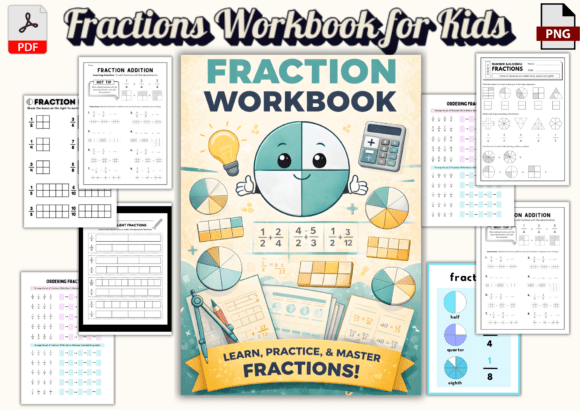
Let’s start with the basics. This isn’t a typical workbook filled with dense pages of equations. Instead, the Fractions Workbook for Kids is an 18‑page printable resource (including covers) designed at the conveniently portable 6‑by‑9‑inch format. Every element — from the pie charts to the fraction bars — is crafted to turn abstract numbers into something a child can see and touch.
The workbook includes:
- Visual fraction models such as pie charts and fraction bars that build intuitive understanding.
- Real‑world examples that connect fractions to everyday situations — sharing pizza, measuring ingredients, dividing a set of toys.
- Interactive exercises that encourage writing, drawing, and problem‑solving rather than passive reading.
- High‑quality PDF and PNG files, making it easy to print at home or use digitally on a tablet.
- Eye‑catching cover designs that appeal to young learners and make the workbook feel like a “real” book.
These features matter because they address a core challenge: children learn fractions best when they can represent them visually and manipulate them physically. The workbook’s design leans into that insight. It’s not just a product — it’s a response to how children actually learn.
Broader Trends Driving Interest in This Kind of Resource
The popularity of the Fractions Workbook for Kids does not exist in a vacuum. Several converging trends explain why parents, teachers, and homeschoolers are actively seeking out resources like this one.
The Homeschooling and Micro‑Schooling Boom
Over the past five years, the number of families choosing to educate outside traditional school systems has grown substantially. Whether driven by a desire for customised learning paths, concerns about classroom size, or the flexibility of remote work, these families need high‑quality, self‑contained resources that a parent can implement without a teaching degree. A printable workbook that covers a specific topic — like fractions — fits perfectly into this ecosystem. It offers focus without overload, and it gives parents a ready‑to‑use activity that aligns with grade‑level standards.
The Demand for Print‑on‑Demand and Digital‑First Materials
Screen fatigue is real, especially among younger learners. After a day of digital classes or educational apps, many children benefit from switching to paper‑based activities. Yet educators and parents still want the convenience of instant access. The Fractions Workbook for Kids meets both needs: it’s a digital download that you can print on demand. No waiting for shipping, no wasted inventory. This hybrid model — digital delivery, physical use — is becoming the new standard for supplementary educational content.
The Shift from Memorisation to Conceptual Understanding
Mathematics pedagogy has undergone a significant shift. Research increasingly shows that students who understand the why behind a procedure perform better and retain knowledge longer than those who simply memorise steps. Fractions, with their need for proportionality and equivalence, are a natural candidate for this approach. The workbook’s use of pie charts and fraction bars directly supports conceptual understanding by showing how fractions relate to whole numbers and to each other. This isn’t a workbook that asks a child to repeat “1/4 + 1/4 = 1/2” without context. It asks them to see the parts add up.
The Rise of the “Teacher‑Creator” and the Printable Resource Market
Platforms like Teachers Pay Teachers and Etsy have given rise to a new breed of educator‑entrepreneurs who design their own materials. Parents and teachers now expect polished, professional, and kid‑tested resources — not photocopied worksheets from a 1990s textbook. The Fractions Workbook for Kids – Fun Engaging Math Practice reflects this elevated standard. The clean layout, modern typography, and thoughtful use of colour show that someone who understands both children and design created it. This isn’t an afterthought; it’s a deliberate, high‑quality learning tool.
Why People Are Paying Attention — and What It Says About Changing Needs
Educators and parents are not just looking for “fraction practice.” They are looking for efficiency, engagement, and alignment with how children learn today. The attention this workbook receives is a signal of deeper shifts in expectations.
- Efficiency: A focused 18‑page workbook can be completed over several sessions, giving a child mastery without burnout. Busy parents and teachers appreciate that it targets one concept deeply rather than skimming a dozen topics.
- Engagement: Visual models and hands‑on exercises convert math practice from a chore into a puzzle. Children willingly return to it. That alone is a game‑changer for many families.
- Flexibility: The 6x9‑inch size is deliberately chosen. It fits in a backpack, on a lap, or in a small workspace. It doesn’t overwhelm a child with a huge page of problems. And because it’s printable, you can reprint a page if a child wants to try again — a small but meaningful feature.
- Ownership: When a child works through a workbook that looks and feels professional, they take pride in the process. The attractive covers and clean interior design communicate that this material matters — and by extension, the child’s effort matters.
These factors are not incidental. They represent a redefinition of what “good” educational content looks like. Gone are the days when a bland worksheet was acceptable. Today’s learners — and their parents — expect aesthetic quality alongside pedagogical soundness.
Practical Examples of the Workbook in Action
To understand the workbook’s real impact, consider three scenarios where it becomes a powerful tool.
Scenario 1: The Homeschooling Parent
Sarah teaches her second‑grader at home. She has a curriculum for the year, but fractions have always felt abstract to her son. She downloads the Fractions Workbook for Kids, prints three pages, and sits with him at the kitchen table. The pie charts let him colour in parts as he counts. Within twenty minutes, he’s explaining that “three‑quarters is bigger than one‑half” by pointing to the visual models. Sarah didn’t need to invent an activity — the workbook did the instructional design for her. She becomes the guide, not the lecturer.
Scenario 2: The Classroom Teacher’s Differentiation Station
Mr. Patel teaches a mixed‑ability third‑grade class. Some students grasp fractions quickly; others need repeated exposure. He keeps a digital copy of the workbook and prints select pages for small‑group work. The fraction bars help struggling students see equivalences visually, while the problem‑solving exercises challenge advanced learners. Because the workbook is printable, Mr. Patel can pull exactly the pages he needs — no more, no less. It becomes a differentiation tool that adapts to his students’ zones of proximal development.
Scenario 3: The After‑School Tutor
Maria tutors elementary students online. She uses a tablet and shares her screen. With the PNG files of the workbook, she can zoom in on a pie chart and ask the child to “show me three‑eighths.” The child draws on their own printed copy at home. The shared visual language makes the session productive. Maria notes that the workbook’s design — clean, uncluttered — reduces cognitive load, allowing the child to focus on the math rather than decoding a busy page.
These examples illustrate something important: the Fractions Workbook for Kids – Fun Engaging Math Practice is not a one‑size‑fits‑all solution, but it is a flexible one. It adapts to different environments, teaching styles, and learner needs.
Connecting the Topic to Larger Developments in Education and Content Design
The rise of resources like this workbook is part of a broader movement toward modular, high‑design, learner‑centred educational materials. In the past, educational publishing was dominated by large companies producing monolithic textbooks that were expensive, heavy, and quickly outdated. Today, individual creators and small teams can produce targeted resources that are more responsive to what learners actually need.
This trend intersects with several larger developments:
- The gig economy in education: Teachers and subject‑matter experts are increasingly monetising their expertise through digital products. The quality bar is rising because creators have direct access to user feedback.
- The printable renaissance: In a world saturated with screens, physical materials are experiencing a resurgence — but with a twist. They are designed digitally, printed on demand, and often paired with digital versions for flexibility.
- The focus on foundational skills: Amid debates about screen time, curriculum complexity, and learning loss, many educators are returning to the fundamentals. Fractions, multiplication, and reading comprehension are non‑negotiable, and targeted workbooks are the most efficient way to strengthen them.
- The aesthetic turn in learning materials: Research in educational psychology confirms that well‑designed materials improve motivation and reduce anxiety. A child is far more likely to engage with a workbook that looks inviting than one that feels like a photocopied handout.
The Fractions Workbook for Kids sits at the intersection of all these currents. It is small but purposeful, digital but tangible, teacher‑tested but parent‑friendly. It represents a new standard for what a workbook can be.
Looking Ahead: What This Means for Educators, Creators, and Families
The attention that resources like this workbook receive is not a passing trend. It signals a lasting shift toward specialised, beautiful, effective learning tools that put the learner’s experience first. For educators and homeschoolers, it means that high‑quality support is available for even the most challenging topics — no need to reinvent the wheel. For creators and entrepreneurs, it demonstrates that there is a robust market for well‑crafted educational content that solves a real problem.
The Fractions Workbook for Kids – Fun Engaging Math Practice 6x9 Inches is more than a printable PDF. It is a micro‑example of how thoughtful design, pedagogical insight, and understanding of modern learning environments can combine to produce something genuinely useful. It helps a child grasp a concept that will underpin their future work in algebra, geometry, and everyday reasoning. And it does so in a format that respects the time and energy of the adult facilitating the learning.
As the worlds of education, content creation, and parenting continue to converge, resources like this will only become more essential. The question is no longer whether to use a focused workbook for tricky topics like fractions — it’s which one will make the experience effective, engaging, and even fun. The answer, increasingly, is the one that treats learning as both a science and an art: the Fractions Workbook for Kids.