Happy Learning Workbook for Kids: Turning Early Education into an Adventure
Early childhood education has shifted dramatically in recent years. Parents and educators alike are moving away from rigid, rote-learning methods and embracing approaches that blend structure with play. The Happy Learning Workbook for Kids embodies this shift, offering a colorful, interactive activity book designed for preschool and kindergarten children. Rather than simply drilling letters or numbers, this workbook invites young learners to trace, count, match, color, and explore—all while building the foundational skills that matter most. In a world where screen time often dominates, a thoughtfully designed physical workbook provides a tactile, focused, and joyful learning experience that both children and adults can appreciate.
Why a Play-Based Workbook Matters Right Now
The conversation around early learning has evolved significantly. Research consistently shows that children absorb information best when they are actively engaged and having fun. The old model of passive instruction—where a child sits and memorizes—has given way to interactive, multisensory approaches. The Happy Learning Workbook for Kids fits naturally into this trend. It replaces monotony with variety: one page might feature a maze that sharpens spatial reasoning, the next could involve matching animals to their habitats, and another might ask a child to trace the letter B while coloring a bright blue butterfly.
For parents working from home or managing busy schedules, this workbook offers a practical, ready-to-use resource. There is no need to hunt for lesson plans or print separate worksheets. Everything a child needs for daily skill-building is gathered in one place. For classroom teachers, it serves as a supplement that aligns with developmental milestones without requiring extensive preparation. The result is a tool that respects the limited time of adults while maximizing the learning potential of every page.
Building Foundational Skills Through Variety
The strength of the Happy Learning Workbook for Kids lies in its breadth. Early learning is not a single skill but a constellation of abilities—language, math, emotional intelligence, fine motor control, and critical thinking. This workbook addresses each of those areas deliberately.
Alphabet and Number Practice
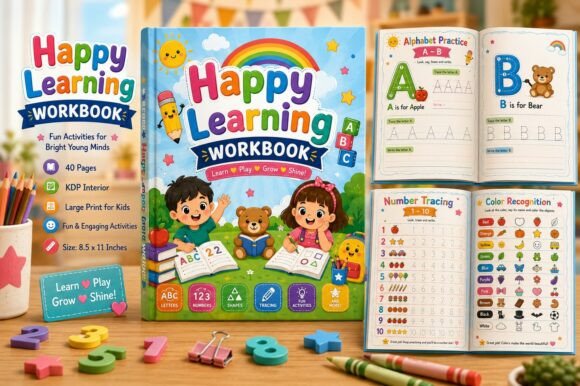
Learning to recognize and write letters and numbers is a cornerstone of early education. The workbook includes tracing activities for both the alphabet (A–Z) and numbers 1 through 20. But these are not dry, repetitive drills. Each tracing page is accompanied by playful illustrations and gentle prompts that keep children engaged. When a child traces the number 5 and then counts five oranges on the page, the abstract symbol becomes connected to a real-world quantity. This kind of contextual learning builds understanding rather than mere memorization.
Colors, Shapes, and Visual Discrimination
Identifying shapes and colors is more than an art lesson—it is the foundation of visual discrimination, a skill that underpins reading and mathematics. The workbook includes interactive pages where children match shapes, name colors, and combine them in creative ways. A child who can distinguish a circle from a square is also building the same cognitive pathways used to differentiate the letter b from d.
Simple Addition and Subtraction
Math anxiety often begins early, but it does not have to. By introducing addition and subtraction through pictures and familiar objects, the workbook makes early math feel approachable. A page might ask, "If there are three apples and you eat one, how many are left?" The child counts the remaining apples and writes the answer. This gentle, visual approach helps young learners grasp the concept of quantity before they ever encounter abstract symbols on a page.
Emotions and Good Habits
One of the most forward-looking features of this workbook is its inclusion of emotional and social learning. Pages dedicated to emotions help children identify feelings like happiness, sadness, surprise, or frustration. They are encouraged to draw faces, describe what makes them feel a certain way, and practice good habits like sharing, saying thank you, and taking turns. In an era where social-emotional learning is recognized as essential for long-term success, this content is not just a bonus—it is a necessity.
How the Workbook Supports Modern Learning Environments
The landscape of education has changed. Many families now blend homeschooling, remote learning, and traditional classroom attendance. The Happy Learning Workbook for Kids adapts to any of these settings seamlessly. Its page size (8.5 × 11 inches) is standard, making it easy to photocopy or laminate for repeated use. The included high-quality PDF files are ready to upload, whether for printing at home, distributing to students digitally, or using in a classroom setting.
For creators and educators who produce their own materials, this workbook can serve as a template or inspiration. The structure is clear and repeatable, and the variety of activity types—tracing, matching, mazes, coloring, math—means it can be adapted for different age groups or learning levels.
Practical Benefits for Parents and Teachers
- No prep time. Open the book or PDF and start learning immediately.
- Progressive difficulty. Activities build on each other, so children develop confidence step by step.
- Engagement that lasts. The mix of activities keeps children interested longer than a single-type worksheet would.
- Tangible progress. The Certificate of Achievement at the end provides a meaningful reward that children can take pride in.
The Role of Handwriting and Fine Motor Development
In a digital age, handwriting sometimes gets overlooked. Yet occupational therapists and early childhood specialists consistently emphasize the importance of fine motor practice for young children. Tracing letters, numbers, and words helps strengthen the small muscles in the hand that are essential for writing. The Happy Learning Workbook for Kids includes word tracing and sight words practice that directly supports this development. When a child traces the word "cat" and then sees a picture of a cat, the connection between the written word and the concept solidifies.
Maze activities add another layer. Navigating a maze requires controlled pencil movement, planning, and problem-solving. These seemingly simple puzzles are actually powerful tools for developing concentration and hand-eye coordination.
Encouraging Curiosity and a Love for Learning
Perhaps the most valuable outcome of any early learning tool is the attitude it fosters. A child who associates learning with fun, discovery, and a sense of accomplishment is far more likely to become a lifelong learner. The Happy Learning Workbook for Kids is designed with this in mind. The illustrations are colorful and friendly. The activities feel like games. And the variety ensures that no two sessions feel exactly the same.
Consider a typical page from the animal, fruit, and weather learning section. A child might be asked to match a banana to the color yellow, connect an umbrella to a rainy day, or count how many puppies are playing in a field. These tasks are simple enough to be achievable, yet engaging enough to hold attention. The child learns without feeling like they are being taught. That is the hallmark of effective early education.
What This Means for Creators and Professionals
For those in the business of creating educational content—whether you are a blogger, a curriculum designer, a freelance educator, or a publisher—the Happy Learning Workbook for Kids illustrates several important trends. First, the demand for hybrid resources (both physical and digital) continues to grow. Parents and teachers want options that work in multiple contexts. Second, there is a clear preference for integrated learning. A workbook that covers letters, numbers, shapes, emotions, and habits in one cohesive package is more appealing than a set of disconnected worksheets. Third, the emphasis on emotional intelligence is no longer optional. Including sections on feelings and good habits meets a real and growing need.
If you are developing your own educational products, consider how the principles embedded in this workbook can inform your work. Think about the user experience: Is the content varied enough to hold attention? Are the instructions clear enough for a parent or teacher to use without preparation? Does the product offer a sense of completion or reward? These are the details that separate a resource that gathers dust from one that becomes a daily companion.
Ways to Integrate the Workbook into Daily Routines
Practicality matters. Here are a few realistic ways to use the Happy Learning Workbook for Kids in everyday life:
- Morning warm-up. Spend 10 minutes after breakfast on one or two pages. This sets a focused tone for the day.
- Quiet-time activity. When children need a screen break, the workbook offers a calm, productive alternative.
- Travel companion. Slip a few printed pages into a bag for car rides or waiting rooms. The activities are self-contained and require only a pencil or crayon.
- Classroom station. Teachers can place the workbook at a learning center and rotate pages to match the weekly theme.
- Bonding time. Work through a page together and talk about what the child is learning. The conversation itself reinforces the lesson.
Thoughts on Long-Term Value
Trends in education come and go, but certain fundamentals endure. Children need to feel safe, engaged, and capable. They need opportunities to practice fine motor skills, to build early math and literacy concepts, and to understand their own emotions. The Happy Learning Workbook for Kids addresses all of these with a design that feels fresh but not gimmicky. It does not promise to make a child a genius overnight. Instead, it offers something more valuable: a structured, enjoyable path toward the skills that prepare a child for school and for life.
For the adults who guide these young learners, the workbook is a reminder that learning does not have to be complicated. A well-designed page, a little encouragement, and a few minutes of focused time can make a real difference. In a world full of noise and distraction, that kind of simplicity is worth holding onto.