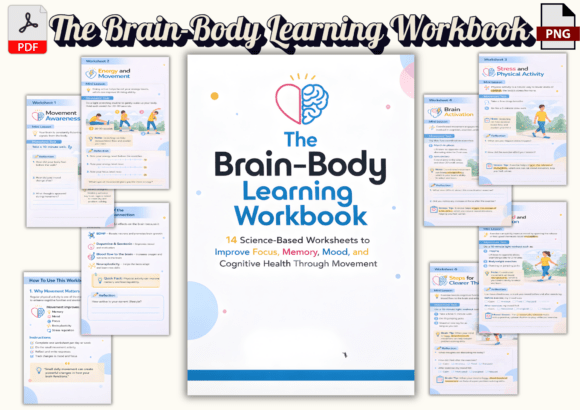
Understanding the Brain–Body Learning Workbook: A Practical Look at Movement-Based Cognitive Health
When exploring resources for improving focus, memory, or mood, it is easy to encounter a wide range of options—from apps and online courses to books and structured programs. Many of these rely on passive information consumption: reading, watching, or listening. The Brain–Body Learning Workbook takes a different approach by placing physical movement at the center of the learning process. Designed as a 15-page, 6 x 9 inch printable workbook, it combines short educational mini-lessons with interactive worksheets that encourage users to move, reflect, and build daily habits. This article examines what makes this workbook distinct, compares it with other common brain health resources, and outlines the situations where it may—or may not—be the right fit for your needs.
What the Brain–Body Learning Workbook Offers and How It Works
The workbook is built around a simple premise: physical activity and cognitive performance are deeply linked. Each page guides readers through a short lesson on a specific aspect of the mind-body connection, followed by a movement challenge or reflection prompt. Topics cover memory, focus, mood, stress reduction, and overall brain health. The activities are designed to be small and manageable—often taking just a few minutes—so they can fit into a daily routine without feeling overwhelming.
The format is intentionally straightforward. Users receive the workbook as a PDF or PNG file, print it at home, and work through it at their own pace. The clean, modern layout with colorful illustrations keeps the experience engaging without being distracting. For students, teachers, parents, coaches, or anyone curious about cognitive health, this structure offers a low-barrier entry point into a field that can sometimes feel academic or inaccessible.
Key Components: Mini-Lessons, Interactive Worksheets, and Movement Challenges
Each of the 15 pages serves a distinct purpose. The mini-lessons provide a concise explanation of a concept—for example, how brief physical movement can increase blood flow to the brain or reduce cortisol levels. The worksheets then ask users to apply that concept through a guided activity, such as a short stretch, a breathing exercise, or a movement sequence. Reflection questions encourage users to notice changes in their mental state, energy, or focus after completing the activity. This loop of learning, doing, and reflecting is central to the workbook’s design and distinguishes it from resources that only deliver information.
How It Compares to Other Brain Health Resources and Approaches
To evaluate whether the Brain–Body Learning Workbook fits your situation, it helps to consider it alongside other common categories of brain health resources. The comparison is not about declaring one superior, but about understanding tradeoffs in format, depth, interactivity, and personalization.
Digital Courses vs. Printable Workbooks: A Question of Format and Commitment
Many brain health programs are delivered as digital courses with video lessons, quizzes, and community forums. These often provide more depth and structure, sometimes spanning several weeks. However, they typically require a higher time commitment, an internet connection, and often a subscription or one-time fee. The workbook, by contrast, is a one-time purchase that you print and use offline. It requires no screen time during use, which can be a relief for those already spending hours in front of a display. The tradeoff is that the workbook offers less content and no interactive feedback. If you thrive on guided instruction from a live instructor or community support, a digital course might feel more engaging. If you prefer a self-paced, offline tool that you can pick up and put down easily, the workbook may be more practical.
Movement-Based Learning vs. Passive Information Consumption
Traditional books about brain health often explain concepts through text and diagrams. While valuable, they ask the reader to learn by reading alone. The Brain–Body Learning Workbook adds a kinesthetic layer: you are expected to move. This can be a strength for individuals who learn by doing or who have struggled to apply advice from books. On the other hand, if you are looking for a deep theoretical understanding of neuroscience or cognitive psychology, a conventional book or academic paper will provide far more detail. The workbook is not designed to replace those resources; it is designed to complement them by translating theory into brief, repeatable actions.
Strengths and Tradeoffs of the Brain–Body Learning Workbook
Every resource has strengths and limitations. Understanding these can help you decide whether this workbook aligns with your goals.
Strengths: Accessibility, Engagement, and Science-Backed Foundations
- Low cost and easy to start: At 15 pages and available in common file formats, the workbook is inexpensive and requires no special equipment. You just need a printer and a willingness to move.
- Engaging format: The combination of illustrations, short lessons, and reflective questions keeps the experience active rather than passive. Users are less likely to skim or lose interest.
- Practical for daily routines: Activities are designed to take a few minutes, making it realistic for busy adults to incorporate into their day. The workbook encourages habit formation without demanding large time blocks.
- Strong for specific audiences: Teachers and parents looking for classroom brain-break activities or homeschool movement integration will find the workbook immediately usable. Coaches and trainers working on mental performance may also appreciate its simple structure.
Tradeoffs: Depth, Interactivity, and Personalization Limitations
- Limited depth: Each page covers only one concept. Users seeking a comprehensive understanding of neuroplasticity, nutrition, sleep, or stress physiology will need to look elsewhere. The workbook is an introduction, not an encyclopedia.
- No personalization: The activities are general and not tailored to specific cognitive challenges, fitness levels, or preferences. Someone with chronic pain or limited mobility may need to modify movements on their own.
- No digital feedback: Unlike apps that track progress or provide reminders, the workbook relies on the user to stay consistent. There is no built-in accountability system beyond the structure of the pages themselves.
- Printable format only: If you prefer digital-only tools that live on your phone or tablet, the PDF/PNG format may feel less convenient. You will need to print the pages to use them fully.
When the Brain–Body Learning Workbook Is a Strong Fit
Certain scenarios make this workbook a particularly good choice.
For Classroom Brain Breaks and Homeschool Settings
Teachers often need quick, structured activities that can be done in a classroom without much setup. The workbook’s movement challenges can be used as brain breaks between lessons. Parents homeschooling multiple children can print copies for each child and use the workbook as a daily warm-up or wind-down activity. The science-based mini-lessons give educators a ready-made explanation for why movement matters, which can be shared with students or integrated into broader lessons on health or biology.
For Individuals Exploring the Mind-Body Connection
If you are curious about how physical activity affects your focus or mood but are not ready to commit to a full program, the workbook offers a low-stakes starting point. The short format lets you experiment with small movements over a few weeks and observe the effects. The reflection prompts help you notice patterns, which can build self-awareness and motivation to continue.
When You Might Need a Different Approach
No single resource works for everyone. Recognizing when to choose an alternative is just as important as knowing what a resource offers.
When Clinical Support or Deep Personalization Is Required
If you are managing a diagnosed cognitive or mental health condition—such as ADHD, anxiety disorder, or traumatic brain injury—a workbook alone is unlikely to provide sufficient support. Those situations typically require individualized guidance from a healthcare professional, therapist, or specialized coach. The workbook can complement professional care but should not replace it. Similarly, if you have physical limitations that prevent you from performing certain movements, a more tailored program with modifications would be safer and more effective.
When You Prefer Digital-Only or More Comprehensive Programs
If your learning style favors apps with reminders, progress tracking, and multimedia content, a printable workbook may feel static. There are many brain training apps, guided meditation programs, and online courses that offer interactive features. Some of these also incorporate physical activity, though often through video demonstrations or gamified challenges. For those who want a complete system covering sleep, nutrition, stress management, and social connection in equal depth, a multi-module program or a comprehensive book on lifestyle medicine might be a better fit.
Decision Factors to Consider Before Choosing
To decide whether the Brain–Body Learning Workbook is right for you, ask yourself a few questions:
- What format works best for my daily life? Do I want something printable, or do I prefer digital tools? Am I willing to print and keep track of physical pages?
- How much time can I realistically commit? The workbook works best when used consistently for a few minutes each day. If I cannot maintain that rhythm, will I still find value in the occasional use?
- What depth of information do I need? Am I looking for a quick overview and practical actions, or do I want to understand the underlying science in depth? The workbook leans toward the former.
- Who will use this? If I am a teacher, parent, or coach, the workbook’s group-friendly format is a clear advantage. If I am an individual with very specific cognitive goals, I may need something more tailored.
- What is my current level of familiarity with the mind-body connection? If I am completely new to this topic, the workbook provides a gentle introduction. If I have already read several books or taken courses, it may feel too basic.
Final Thoughts on Choosing the Right Brain Health Resource
The Brain–Body Learning Workbook occupies a specific niche: it is a low-cost, low-commitment, movement-focused introduction to cognitive health that is best suited for those who learn by doing. Its greatest strength lies in its simplicity and accessibility, especially for classroom, homeschool, or personal exploration settings. Its limitations include limited depth, lack of personalization, and a format that requires printing and self-direction. By comparing it with digital courses, traditional books, and more comprehensive programs, you can assess where it fits into your broader approach to brain health. For many readers, the workbook serves as a starting point—a way to build awareness and small habits before diving deeper. For others, it will be a complete enough tool to support daily practice. Understanding these tradeoffs is the key to making an informed choice that aligns with your goals, preferences, and circumstances.