Parts of Speech Grammar Workbook: A Visual Approach to Mastering English Grammar
If you have ever tried to explain the difference between an adjective and an adverb to someone learning English, you know how quickly things can get tangled. Even native speakers sometimes stumble over when to use “good” versus “well.” The Parts of Speech Grammer Workbook (spelled exactly as titled) aims to cut through that confusion with a colorful, visual approach. Designed for students, ESL learners, teachers, and writers, this 23-page digital resource breaks down the nine parts of speech into clear, easy-to-digest pages. But like any learning tool, how you use it matters as much as having it. Let us walk through the common pitfalls, practical corrections, and better ways to make this workbook work for you.
What Makes This Workbook Different
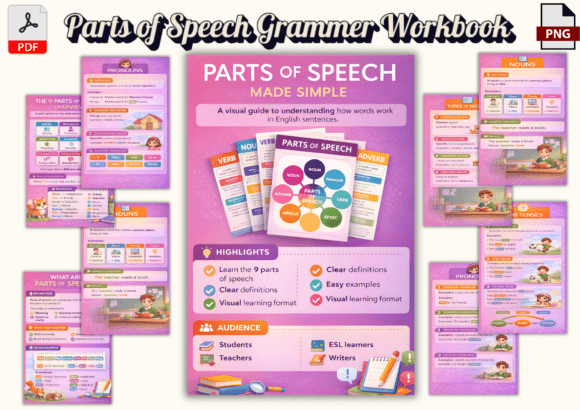
The workbook emphasizes visual learning. Instead of dense paragraphs of text, each page uses layouts, colors, and examples to help you see how nouns, verbs, pronouns, adjectives, adverbs, prepositions, conjunctions, interjections, and articles fit together. That can be a game-changer if you have struggled with traditional grammar books that read like legal documents. The Parts of Speech Grammer Workbook comes as a high-resolution PDF and 23 individual PNG files, so you can print the pages or use them digitally. The size is 6 x 9 inches, compact enough to fit in a binder or on a tablet screen.
But here is the thing: visual aids only help if you actually engage with them. Some learners flip through colorful pages, enjoy the design, and then forget to apply what they saw. The workbook is a reference and a teaching tool, not a magic wand. Knowing that upfront helps you avoid the mistake of treating it like a one-time read.
Mistake 1: Treating All Parts of Speech as Equally Simple
One of the most frequent missteps is assuming that nouns, verbs, and adjectives are easy, so you rush past them. Meanwhile, prepositions, conjunctions, and interjections get less attention because they seem less important. That imbalance can leave gaps in your understanding. For example, a learner might nail noun and verb definitions but still struggle with when to use “in,” “on,” or “at.” The workbook covers all nine parts, but it is up to you to spend time on the tricky ones.
Better approach: Use the workbook to identify which parts of speech you find hardest. Start with the pages that feel less comfortable. If prepositions always trip you up, flip to that section first. Read the examples out loud. Write your own sentences using the same pattern. The visual layout makes it easy to compare how each part of speech functions, but you have to direct your attention where it matters most.
Mistake 2: Ignoring the Visual Cues
The workbook is designed with bright, eye-catching visuals for a reason. Yet some learners treat the images as decoration rather than learning aids. If you skip over the color coding, icons, or layout choices, you miss half the benefit. Visual cues help your brain categorize and recall information faster. When you see a verb represented by an action image and a noun represented by a person or object, your memory forms a stronger link.
Better approach: Before you read the text on a page, spend ten seconds looking at the visuals. Ask yourself what the image or color might represent. Then read the definition and examples. Afterward, cover the text and try to recall the concept just from the visual. That simple habit can double your retention. The Parts of Speech Grammer Workbook is built for this kind of active learning, so let the design do its job.
Mistake 3: Skipping Real-Life Application
Real-life examples are one of the workbook’s strengths. Each part of speech comes with examples you might actually use in conversation or writing. But some learners read the examples and move on without creating their own. That is like watching someone else swim and expecting to learn how to swim yourself. Grammar sticks when you use it in contexts that matter to you.
Better approach: After studying a page, write three sentences that use the part of speech in a situation from your own life. If you learned about adverbs, describe how you do something: “I speak clearly during meetings,” or “She writes quickly before deadlines.” If the workbook shows an example using a generic noun like “dog,” replace it with something relevant to your world, like “project,” “client,” or “lesson plan.” Personal connections make grammar memorable.
Mistake 4: Overlooking Articles and Interjections
Articles (“a,” “an,” “the”) and interjections (“Wow!,” “Oops!”) are easy to dismiss as too simple or too small to matter. But articles cause persistent errors for many ESL learners, and interjections add natural flavor to spoken English. The workbook gives them their own space, and that is a signal they deserve attention. A learner who ignores articles might say “I need pen” instead of “I need a pen,” which immediately marks their English as incomplete. Similarly, without interjections, spoken English can sound robotic.
Better approach: Treat articles and interjections with the same seriousness as verbs and nouns. Use the workbook’s dedicated pages to practice article usage with different nouns. Notice patterns: “a” before consonant sounds, “an” before vowel sounds, “the” when referring to something specific. For interjections, practice adding them to short dialogues you write or say aloud. The workbook page on interjections includes examples that show tone and emotion, which is especially helpful for ESL learners who want to sound natural.
Mistake 5: Using the Workbook Only Once
Many people download a PDF, read through it once, and file it away. That is a missed opportunity. The Parts of Speech Grammer Workbook works best as a reference you return to. Grammar is not something you master in a single sitting. You might nail adjectives today but need a refresher on conjunctions next week. The workbook’s compact size and clear layout make it ideal for quick lookups.
Better approach: Keep the PDF or a printed copy near your workspace. When you are writing something and feel uncertain about a part of speech, open the workbook and check. Over time, those repeated checks turn into automatic knowledge. You can also use the PNG files to create flashcards or add individual pages to digital notes. A one-time read is helpful; repeated, active use is transformative.
What to Check Before You Download or Buy
Before you invest time in this workbook, there are a few things to verify so it meets your needs.
First, check the spelling acknowledgment. The workbook title uses “Grammer” rather than the standard “Grammar.” This is the official title of the product, so it is not an error in your copy. But if you are sensitive to spelling conventions, you should know this going in so it does not distract you. The content inside follows standard English grammar rules, so the spelling in the title is a stylistic choice or branding, not a reflection of the teaching quality.
Second, consider your learning format. The workbook is available as a PDF and 23 PNG files. If you prefer physical books, you will need to print the pages yourself. The 6 x 9 inch size prints well, but check your printer settings to avoid cutting off margins. If you plan to use it digitally, the PNG files allow flexible use on tablets, phones, or computers. Decide in advance how you will access it, so you do not download a file you cannot easily use.
Third, assess your current level. The workbook is designed for learners of all levels, but it is especially strong for beginners and intermediate learners. If you are an advanced writer looking for deep grammatical analysis, you might find the content too basic. In that case, the workbook still works as a quick visual reference or a teaching resource for others. If you are a teacher, consider using the printable PNG files as classroom posters or handouts.
Fourth, verify the file compatibility. The product is delivered as a high-resolution PDF and PNG files. Make sure your device or software can open these formats. Most modern devices can, but if you are on an older system or use niche software, test the sample page if one is available. There is nothing more frustrating than purchasing a digital product you cannot open.
How to Get the Most Out of This Workbook
Practical advice goes a long way. Here are proven strategies to maximize the value of the Parts of Speech Grammer Workbook.
- Pair it with writing practice. After studying a page, write a short paragraph that uses that part of speech at least five times. Challenge yourself to use it in different ways.
- Use the PNG images for spaced repetition. Import the individual page images into a flashcard app like Anki or Quizlet. Review one page per day. Spaced repetition locks information into long-term memory.
- Teach someone else. Explain a part of speech to a friend, colleague, or student using the workbook page as your guide. Teaching forces you to clarify your own understanding.
- Combine with audio and conversation. Grammar is not just written. Listen for the parts of speech in podcasts, videos, or conversations. Notice how native speakers use articles, prepositions, and conjunctions naturally.
- Make it a weekly habit. Dedicate 15 minutes each week to reviewing one part of speech. The workbook is short enough that you can cycle through all nine in a couple of months, then start again.
Why This Approach Matters for Communication
Grammar is not about being perfect. It is about being clear. When you use the right part of speech in the right place, your reader or listener does not have to guess your meaning. The difference between “I only ate vegetables” and “I ate only vegetables” changes the entire message, and that shift comes down to adverb placement. The Parts of Speech Grammer Workbook gives you the building blocks to communicate with precision.
For ESL learners, mastering parts of speech reduces the frustration of being misunderstood. For teachers, having a visual resource saves time explaining concepts that are easier to show than tell. For writers, a quick refresher on conjunctions or prepositions can tighten prose and eliminate awkward phrasing. And for anyone who uses English daily, a solid grasp of grammar builds confidence.
The workbook is not a complete grammar curriculum, and it is not meant to be. It is a focused, visual guide that simplifies the most foundational part of English grammar. Used well, it can fill gaps you did not realize you had. Used passively, it becomes just another file in your downloads folder. The difference is how you choose to engage with it.
Final Thoughts Before You Start
When you open the Parts of Speech Grammer Workbook, do not rush. Spend time on each page. Look at the colors, read the examples, and think about how each part of speech shows up in your own speaking and writing. Notice which sections feel easy and which ones challenge you. That awareness is the first step to real improvement.
Set a small goal. Maybe this week you learn to use articles correctly every time. Next week you focus on prepositional phrases. The workbook supports step-by-step learning because each part of speech is presented independently, but they all connect. Celebrate small wins, and do not be afraid to revisit pages. Mastery comes from repetition, and repetition works best when the material is clear and enjoyable.
Grammar does not have to be dry or intimidating. With a visual guide, real-world examples, and intentional practice, you can build a strong foundation that serves you for years. The Parts of Speech Grammer Workbook is a tool that makes that process a little easier, a lot more colorful, and genuinely useful for anyone ready to improve their English.