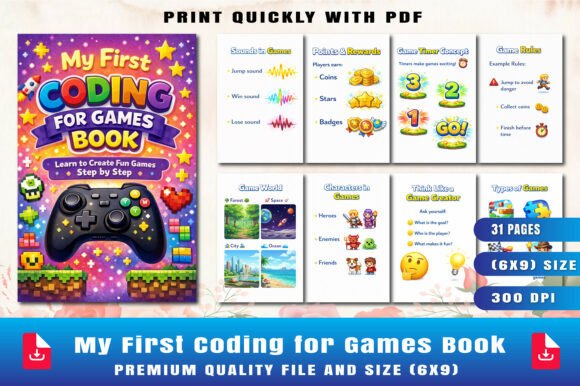
My First Coding for Games Book: A Practical Guide to Avoiding Common Pitfalls When Introducing Kids to Game Design
Teaching children how games work is a delicate balance between sparking creativity and building real technical understanding. Many parents and educators jump into coding resources without checking whether the material actually teaches foundational concepts or just fills pages with pretty illustrations. My First Coding for Games Book attempts to bridge that gap, but like any learning tool, its effectiveness depends on how you use it and what you expect from it. This article walks through the most common mistakes people make when introducing game coding to beginners, and how to avoid them so the experience is genuinely productive and fun.
Mistake One: Treating the Book as a Complete Curriculum
The biggest misunderstanding about activity-based coding books is assuming one resource covers everything a child needs to become a game developer. My First Coding for Games Book offers 31 colorful pages covering game rules, character design, points, levels, sounds, and basic logic. That is an excellent starting point, but it is not a full computer science course. Beginners who finish the book and expect to build a complete, polished game from scratch will feel frustrated unless you set realistic expectations.
Think of this book as a guided tour of game design thinking, not a technical manual. It introduces concepts like winning and losing mechanics, reward systems, and world building in a visual, low-pressure format. The real learning happens when you extend those ideas into actual digital tools or simple programming environments afterward. If you treat the book as the entire journey rather than the first step, you risk leaving young learners stuck between knowing what a game should do and having no idea how to implement it.
Better approach: Use the book to build vocabulary and confidence. After completing a few pages, introduce a free tool like Scratch or a simple game engine to bring those character sketches and level ideas to life. The book becomes the inspiration; the computer becomes the workshop.
Mistake Two: Overlooking the Prerequisite Age and Reading Level
Just because a book says it is for beginners does not mean every beginner will find it accessible. My First Coding for Games Book is designed with a 6x9 inch format and 31 pages of visually rich content, but the concepts around game rules, logic, and systems still require a certain level of reading comprehension and abstract thinking. Parents sometimes hand this to a six-year-old expecting independent learning, only to find the child needs constant explanation of terms like "coding logic" or "reward systems."
The result is either abandonment of the material or a frustrated adult who ends up doing most of the work. Neither outcome helps the child develop independence or genuine interest. The book works best when an adult or older sibling sits alongside the learner, reading prompts aloud and discussing what each activity means in concrete terms.
What to check before buying: Look at sample pages carefully. If the vocabulary or page density seems high for your particular child, plan to use the book as a shared activity rather than an independent workbook. For younger kids, focus on the drawing and brainstorming sections first, then gradually introduce the rule-based pages as their comprehension grows.
Mistake Three: Ignoring the Difference Between Game Design and Coding
Many people buy My First Coding for Games Book expecting it to teach actual programming syntax or drag-and-drop coding blocks. The title says "coding for games," which understandably leads to that assumption. In reality, this book emphasizes game design thinking: how characters behave, what makes a level fun, why rules matter, and how points and lives create engagement. Those are essential precursors to coding, but they are not coding itself.
When parents or teachers realize the book contains drawing activities and brainstorming prompts rather than code examples, they sometimes feel misled. This mismatch between expectation and delivery can cause the resource to be undervalued or set aside. The book does include "simple coding logic examples," but these are conceptual, not executable. They explain ideas like sequences and conditions without requiring a computer.
Practical advice: Read the product description for what it says, not what you hope it says. If your goal is to teach Python or JavaScript to a child, this book will not do that. If your goal is to help a child understand why games are structured the way they are, and to spark curiosity about how they could build their own, this book delivers that well. Pair it with a coding platform afterward, and you have a complete learning arc.
Mistake Four: Skipping the Creative Activities to Rush to "Real" Lessons
Adults often undervalue drawing and brainstorming activities because they do not look like traditional learning. My First Coding for Games Book includes creative prompts for designing characters, mapping game worlds, and imagining level layouts. Some users skip these pages or treat them as optional warm-ups, eager to get to the "serious" concepts like points systems or win conditions.
This is a mistake. The creative sections build mental models that make the later logic pages meaningful. A child who has already designed a character and decided what that character can do will understand rules and abilities far better than a child who jumps straight into abstract systems. The book's structure exists for a reason: creativity feeds logic, and ignoring one half weakens the other.
Better approach: Treat the creative activities as the foundation. Spend time on the drawing and brainstorming pages. Ask questions like "Why does your character have that power?" and "What happens if the player makes a mistake?" Those discussions are where real learning about game mechanics happens. The later pages will feel like natural extensions rather than disconnected lessons.
Mistake Five: Expecting a Digital or Interactive Experience from a Print Resource
My First Coding for Games Book is delivered as high-quality JPG files and a ready-to-print PDF. That means it is a static, printable resource. Some buyers assume that because it is about coding and games, it will include clickable links, animations, or interactive elements. When they receive a set of printable pages, they feel disappointed or unsure how to use them effectively.
This misunderstanding affects usability and satisfaction. A parent who expected an interactive eBook may print the pages and then wonder what to do next. The book requires active participation: someone has to read, discuss, draw, and brainstorm. It does not deliver feedback or progress tracking on its own.
What to do instead: Before purchasing, decide whether you want a screen-based interactive experience or a printable workbook that requires human facilitation. This resource excels in the latter category. Use it in short sessions, five to ten minutes per page. Discuss each activity out loud. Celebrate the drawings and ideas. The value comes from the conversation around the pages, not from the pages themselves.
Mistake Six: Underestimating the Value of Repetition and Revisiting
Many people go through activity books once and then discard them. My First Coding for Games Book covers concepts like game goals, character design, level structure, points, lives, sounds, and winning conditions. A single pass through these topics will not cement them in a young learner's mind. The book is relatively short at 31 pages, which makes it easy to revisit without feeling redundant.
Children often understand a concept differently the second or third time they encounter it. A page about "reward systems" might seem confusing in week one, but after playing a few video games and noticing how coins or points work, that same page becomes a moment of recognition. Treating the book as a one-time resource misses this powerful learning opportunity.
Practical advice: Cycle through the book three times over a few months. The first time, focus on exploration and vocabulary. The second time, connect the concepts to games the child already plays. The third time, use the ideas as a blueprint for a simple digital project. Each pass deepens understanding without requiring new material.
Mistake Seven: Not Aligning the Book's Style with the Learner's Interests
The visual and thematic style of a learning resource matters more than adults usually admit. My First Coding for Games Book uses colorful layouts, fun elements, and a playful tone. That works well for many children, but if a learner prefers realistic or minimalist designs, or if they are already accustomed to more advanced game concepts, the book may feel too young or overly simplified.
This mismatch can cause resistance. A ten-year-old who plays complex strategy games might roll their eyes at a page asking them to draw a simple character. The content is still valuable, but the packaging may not match their self-image as a "serious" gamer or creator.
What to check: Look at the sample images and description to gauge the visual tone. If the learner is older or more experienced, frame the book as a "game design brainstorming tool" rather than a beginner workbook. Emphasize that even professional game designers sketch ideas and map out concepts before coding. The activities are legitimate, not childish, when presented with the right context.
Mistake Eight: Buying Without a Plan for Follow-Through
The most common reason any educational resource fails is lack of structure around its use. Someone buys My First Coding for Games Book with good intentions, but without scheduling time for it, without deciding who will facilitate it, and without connecting it to a larger goal, the PDF sits in a downloads folder or gets printed and forgotten.
This is not a flaw of the book. It is a reality of how busy households and classrooms operate. The difference between a resource that works and one that collects dust is almost always a simple plan: "We will do two pages every Saturday morning" or "This is our after-school activity on Mondays and Wednesdays." Without that plan, even the best material loses its potential.
Better approach: Before you download or print, decide when and how you will use the book. Set a recurring time. Decide who will lead the session. If possible, pair it with a specific outcome, such as "After we finish, we will build a simple game in Scratch using one of our character ideas." A goal gives the activities purpose and momentum.
Mistake Nine: Overlooking the Print Quality and Format Constraints
The book comes as PDF and JPG files with a page size of 6x9 inches. That is smaller than standard letter or A4 paper. Some users print it at full size and find the layout stretched or the images slightly blurry. Others print it at the intended size and realize the font or activity space is smaller than expected for young children who are still developing fine motor skills.
This is a practical detail that affects usability. If the printed pages feel cramped, children may rush through activities or lose interest in the drawing and writing portions. The 6x9 format is designed to feel like a small, friendly booklet, but that works best when printed correctly and bound or stapled neatly.
What to do: Print at the intended size on good quality paper. Consider spiral binding or putting pages in a thin binder so the book lies flat. If the learner prefers larger work areas, use the JPG files to print selected pages at a larger scale rather than the whole book. Adjusting the format to fit the user is a small effort that pays off in engagement.
Mistake Ten: Confusing Simplicity with Lack of Depth
Finally, some adults dismiss My First Coding for Games Book because it looks too simple. They see 31 pages of colorful activities and assume it cannot teach anything substantial about game design or coding logic. This overlooks the fact that deep understanding often comes from simple, clear explanations revisited multiple times.
The book introduces concepts like "if the player collects enough points, they win," which is a direct parallel to conditional logic in programming. It discusses sound and music concepts without requiring audio hardware. It explains lives systems in a way that connects directly to resource management in any game genre. Simplicity is not shallowness; it is accessibility.
Better perspective: Evaluate the book by whether it introduces the right concepts, not by how complex those concepts appear. A child who understands why games have rules and rewards has a cognitive framework that will make actual coding far easier later. The depth is in the thinking, not in the page count or technical jargon.
Final Thoughts on Getting the Most from My First Coding for Games Book
My First Coding for Games Book is a well-designed entry point for young learners and beginners who want to understand how games work from a design perspective. It is not a coding bootcamp in print form, and it does not pretend to be. The value comes from using it intentionally: pairing creative activities with logical concepts, revisiting pages over time, and connecting the ideas to real games and simple digital tools.
Avoid the common mistakes of treating it as a complete curriculum, expecting interactive features, or rushing through the creative sections. Set realistic expectations, plan your sessions, and use the book as a conversation starter rather than a silent workbook. When approached that way, it becomes a genuinely helpful resource that builds curiosity, vocabulary, and foundational thinking skills for anyone interested in making games.
If you are considering this book for a classroom, homeschool setting, or creative playtime, take a few minutes to look at sample pages, think about who will facilitate the activities, and decide how it fits into a larger learning path. That small investment of planning will turn a simple PDF into a meaningful experience that introduces young creators to the logic and joy behind the games they love.