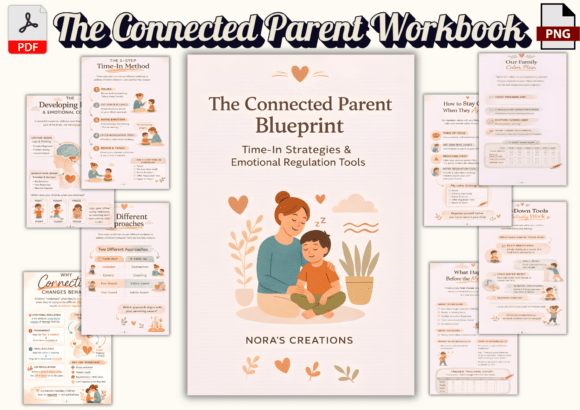
The Positive Parenting Guide Workbook as a Bridge Between Brain Science and Everyday Calm
Parenting a child through moments of intense emotion can feel like navigating a storm without a map. The crying, the shouting, the withdrawal, the sudden refusals—these moments test patience, trigger old patterns, and leave many caregivers wondering what the "right" response actually is. The Positive Parenting Guide Workbook steps into this gap not as a quick fix but as a structured, reflective tool that helps parents understand the neuroscience behind emotional outbursts and then practice concrete, connection-based strategies. It is a resource built on the premise that discipline and closeness are not opposites, but partners in raising emotionally resilient children.
What sets this workbook apart from the countless parenting articles and social media tips is its deliberate format: a printable, 6×9 inch workbook that walks caregivers step by step through the logic of emotional regulation, the mechanics of the Time-In method, and the reflective practice needed to shift from reactive to responsive parenting. For parents of children aged three to twelve—a period when emotional regulation skills are still being wired—this workbook offers a blend of education, self-assessment, and practical planning that can be adapted to any family rhythm.
Why Emotional Regulation in Parenting Requires More Than Willpower
Many parents already know that yelling or punishing a child who is melting down does not teach calm. But knowing is not the same as doing. The gap between intention and response is often filled with stress, exhaustion, and the unconscious habits we grew up with. The Positive Parenting Guide Workbook addresses this gap by explaining how a child's brain processes stress in clear, accessible terms. It describes the difference between the upstairs brain (the prefrontal cortex, responsible for self-control and logic) and the downstairs brain (the limbic system and brainstem, where fight, flight, and freeze responses live).
When a child is flooded with emotion—when they are in the middle of a meltdown about a broken toy or a cancelled playdate—their downstairs brain has taken the wheel. They are not being defiant; they are being dysregulated. A traditional time-out, which involves separation and isolation, can actually escalate this state because the child feels abandoned at the very moment they need connection to calm their nervous system. The workbook helps parents recognize this neurological reality and offers an alternative: the Time-In approach, which keeps the child close, uses co-regulation, and builds the neural pathways for self-regulation over time.
This shift from seeing behavior as "bad" to seeing it as a signal of dysregulation is not just a philosophical change—it is a practical one. The workbook provides worksheets that help parents track behavior triggers, observe patterns, and identify the unmet needs behind the outburst. Instead of asking "How do I make this stop?" parents learn to ask "What is my child's nervous system telling me right now?"
The Time-In Method: A Step-by-Step Calming Framework
One of the core offerings of the Positive Parenting Guide Workbook is its detailed walkthrough of the Time-In method. Unlike time-out, which removes a child from the situation as a consequence, Time-In brings the adult and child together in a calm, quiet space to regulate. The workbook breaks this down into actionable steps: naming the emotion, offering physical closeness (a hug, a hand on the back), breathing together, and waiting until the child's nervous system settles before addressing the issue.
The workbook does not assume that parents already know how to do this. It includes reflection exercises that help adults practice their own regulation first. A parent who is dysregulated cannot co-regulate a child. So there are prompts like: "What sensations do you feel in your body when your child is screaming? Where do you hold tension? What do you need to do to ground yourself before responding?" These journaling prompts are not filler—they are the mechanism through which parents build the internal stability needed to stay present during chaos.
For educators and therapists who use the workbook in their practice, this step-by-step framework is especially valuable. It provides a common language to share with families and a concrete structure to practice during sessions or recommend for home use. The workbook becomes a bridge between clinical knowledge and daily implementation.
Moving Beyond Punishment Toward Skill Building
Many discipline approaches focus on making a child feel bad so they will behave better. The research increasingly shows that this approach does not teach self-regulation; it teaches fear and compliance, which often break down as soon as the authority figure is absent. The Positive Parenting Guide Workbook takes a different path. It treats every challenging moment as a teaching opportunity—a chance to build the skills a child will need for the rest of their life: naming emotions, recognizing physical cues of stress, asking for help, taking a break, and repairing relationships after conflict.
The workbook dedicates significant space to the repair process. After a conflict—whether the parent lost their temper or the child had a meltdown—there is a way to reconnect that actually strengthens trust. The workbook provides scripts and reflection prompts for these repair conversations. For example, a parent might say: "I got upset earlier and I raised my voice. That wasn't the way I wanted to handle that. I'm sorry. Let's try again." This models accountability and shows the child that relationships can withstand rupture and repair, a lesson far more valuable than any consequence.
Weekly Planning Tools for Calmer Routines
One of the most practical sections of the Positive Parenting Guide Workbook is its weekly planning framework. Emotional regulation does not happen in the heat of the moment—it is built in the quiet, predictable rhythms of daily life. The workbook includes templates for mapping out the week with attention to transition times, known triggers, and intentional connection moments.
A parent might note that mornings are consistently chaotic, with rushing, forgotten items, and last-minute demands. Using the workbook's planning tools, they can identify the specific stressors (maybe the child needs a visual checklist, or an extra five minutes of snuggle time before getting dressed) and implement small changes that reduce the likelihood of meltdowns. Over time, these deliberate adjustments become habits, and the household runs more smoothly not because the child is "behaving better" but because the environment and routine are aligned with their developmental needs.
For busy parents, these planning tools are not about adding more to the to-do list. They are about working smarter—using a few minutes of reflection each week to prevent the crises that consume hours. The Positive Parenting Guide Workbook encourages parents to treat their family's emotional health with the same intentionality they would treat a work project or a budget.
Language That Builds Emotional Intelligence
Another standout feature of the workbook is its focus on the specific words and phrases that either open up or shut down communication. Many parents inadvertently use language that dismisses a child's experience: "You're fine," "It's not a big deal," "Stop crying." These phrases may calm a situation in the short term, but they teach children to suppress their emotions rather than process them.
The workbook offers alternative language frameworks. For example, instead of "You're fine," a parent might say, "I see you're really upset. I'm right here with you." Instead of "Stop crying," they might say, "Let those tears out. I'll stay with you until you feel better." These small shifts in language validate the child's inner experience and keep the connection open. The workbook provides practice exercises where parents can write out common scenarios and rehearse the new language, making it more automatic when real moments arise.
How Different Audiences Use the Workbook
The Positive Parenting Guide Workbook was designed for modern families, but its reach extends well beyond individual parents. Therapists use it as a take-home resource for clients working on attachment and emotional regulation. Educators use sections of it to help create calm-down corners and consistent language in the classroom. Business owners and creators who develop content around family wellness use it as a reference or a supplement to their own offerings. Researchers and hobbyists interested in child development find the workbook's synthesis of neuroscience and practical application useful as a starting point for deeper exploration.
Its 19-page printable format makes it easy to distribute, share, or incorporate into a larger curriculum. The 6×9 inch size is intentional—small enough to feel approachable, large enough to contain meaningful content. It does not overwhelm with density, but it does demand engagement. Each worksheet asks the user to write, reflect, or plan. It is a workbook in the truest sense: it works best when the user works inside it.
Identifying Triggers and Building Self-Awareness
A key exercise in the workbook involves mapping a child's behavioral triggers across different settings: home, school, transitions, social situations, and times of fatigue or hunger. Parents are guided to note not just the outward behavior but the context. Does the child melt down before dinner every night? Is the trigger tiredness? Hunger? The need for attention after a long day at school? Once the pattern is visible, the parent can proactively address the root cause rather than reacting to the symptom.
The workbook also asks parents to reflect on their own triggers. A parent who grew up being punished for crying may find it difficult to tolerate their child's tears. Recognizing this internal reaction is the first step toward changing it. The Positive Parenting Guide Workbook treats the parent as a learner too—not as someone who should already have all the answers, but as someone who is building new skills alongside their child.
Long-Term Benefits of Connection-Based Discipline
When parents consistently use Time-In strategies, reflective language, and co-regulation, the results are not immediate perfection. Children will still have meltdowns. Parents will still lose patience. What changes is the arc of recovery. Families using the approaches in this workbook report shorter emotional episodes, faster reconnection after conflict, and a gradual decrease in intense outbursts over time. More importantly, they describe a shift in the overall emotional climate of the home—less tension, more trust, more laughter.
Children who grow up with connection-based discipline internalize the message that they are loved even when they are difficult. They learn that emotions are not dangerous, that relationships can withstand conflict, and that they have the capacity to calm themselves with the support of people who care about them. These are not just parenting outcomes. They are life outcomes. The Positive Parenting Guide Workbook is designed to sow those seeds, one reflection, one worksheet, one calm breath at a time.
Practical Considerations for Getting the Most Out of the Workbook
To use the workbook effectively, consistency matters more than volume. A parent who completes one worksheet per week and actually tries the strategies in real life will likely see more change than someone who reads the entire thing in one sitting and sets it aside. The workbook is designed for repeated use—the reflection exercises can be revisited as the child grows and new challenges emerge.
It is also worth noting that the workbook is not a substitute for professional help when a child has significant mental health needs or a family is in crisis. What it offers is a solid foundation for the majority of typical parenting struggles—the everyday dysregulation that comes from being a small person in a big, confusing world. For therapists and educators, it functions as a complementary tool that supports the work done in sessions or classrooms.
Parents who pair the workbook with a supportive community—whether a parenting group, a trusted friend, or a coach—tend to implement the strategies more consistently. The workbook provides the structure; the community provides the encouragement. Together, they create a sustainable path toward calmer, more connected parenting.
Final Thoughts on Building Emotional Skills Through Structure and Connection
The Positive Parenting Guide Workbook Time-In Strategies Emotional Regulation Tools is more than a collection of pages. It is a deliberate practice tool for one of the most important and challenging roles a person can take on. By grounding its approach in neuroscience, offering specific language and steps, and providing space for reflection and planning, it gives parents a way to move from feeling overwhelmed to feeling equipped. And in a world where children are under more pressure than ever, and parents are often isolated and exhausted, a resource that builds both emotional regulation and connection is not just helpful—it is essential.