Why Every Professional Needs a Project Management Planner to Navigate Modern Work
The nature of professional work has shifted dramatically over the past decade. Teams are more distributed, timelines are tighter, and the margin for error continues to shrink. In the midst of this complexity, a Project Management Planner has emerged not merely as a scheduling tool, but as a strategic operating system for professionals who want to move from reactive task-switching to deliberate, high-impact execution. Whether you are a solo freelancer juggling multiple client engagements or a team leader overseeing a corporate initiative, the ability to organize, strategize, and achieve within a single structured framework is no longer optional—it is foundational.
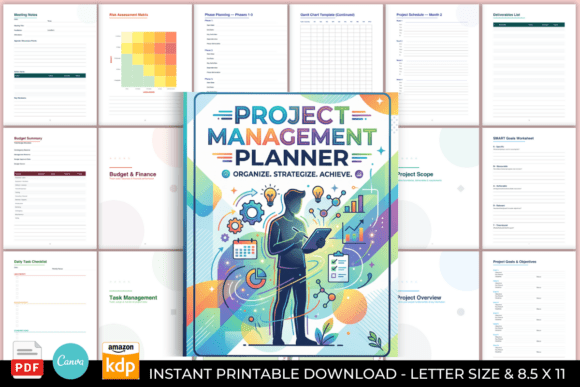
This article explores why the Project Management Planner—a comprehensive 120-page organizational toolkit designed for managers, entrepreneurs, and team leaders—has become a vital resource in today's fast-moving professional landscape. We will examine how it addresses the changing needs of modern work, fits into broader industry and business trends, and provides a tangible path to disciplined execution that goes far beyond simple to-do lists.
The Shift from Activity to Accountability
One of the most significant changes in the professional world over the last five years is the growing demand for accountability at every level. In the past, project success was often measured by busyness—how many meetings were held, how many emails were sent, how many tasks were started. Today, the focus has shifted to outcomes. Professionals, creators, and entrepreneurs are expected to deliver measurable results, often with fewer resources and tighter deadlines.
This shift has created a critical need for a single source of truth that captures scope, timelines, budgets, and team roles in one place. The Project Management Planner answers that need directly. It is built around the understanding that accountability requires clarity from the very beginning. With dedicated sections for Project ID, Manager, Sponsor, and Priority Levels, it forces a level of upfront discipline that many teams lack. Instead of vague objectives, the planner asks users to define clear boundaries and measurable goals, effectively preventing scope creep before it begins.
For entrepreneurs and freelancers, this is especially powerful. When you are working across multiple projects simultaneously, it is easy to lose track of what was promised to whom. A structured planner acts as a contract with yourself and your stakeholders, ensuring that every commitment is visible and trackable.
Why People Are Paying Attention to Structured Planning Tools
Despite the proliferation of digital project management software, there has been a notable resurgence of interest in physical planners and structured paper-based systems. This might seem counterintuitive in an era of AI-powered tools and real-time collaboration platforms, but it reflects a deeper psychological need for focus, ownership, and cognitive offloading.
Research in cognitive psychology suggests that the act of writing things down by hand improves memory retention and reduces cognitive load. When professionals use a Project Management Planner, they are not just documenting tasks—they are encoding information more deeply, which leads to better decision-making and fewer errors. In a world where digital notifications compete for attention every few seconds, a physical planner offers a sanctuary of focused thinking.
Moreover, the trend toward intentional productivity is gaining momentum. Movements like deep work, slow productivity, and mindful execution all emphasize the importance of doing fewer things better. The Project Management Planner aligns perfectly with this philosophy. It does not attempt to gamify productivity with endless checkboxes; instead, it provides a tactical structure for high-leverage activities. Users report that having a physical artifact of their project plan reduces anxiety and increases their sense of control, especially when managing complex initiatives with multiple moving parts.
How the Planner Addresses Changing Workflows and Expectations
The modern professional juggles a blend of synchronous and asynchronous work, cross-functional collaboration, and rapidly shifting priorities. Traditional planning methods—sticky notes, scattered digital files, or generic notebooks—simply cannot keep up. The Project Management Planner is designed with a clear lifecycle approach that mirrors how projects actually unfold in practice.
Phase 1: Strategy Scope is where the foundation is laid. The Project Information Sheet ensures that every stakeholder understands the fundamentals before any work begins. The Scope Objectives section provides a structured way to define what is in bounds and what is out of bounds, which is one of the most common failure points in project management. Without clear boundaries, teams often drift into unproductive areas, wasting time and budget. By dedicating space to this upfront, the planner builds in a safeguard against the single biggest source of project failure.
Risk Assessment is another area where the planner excels. With eight full pages dedicated to identifying potential bottlenecks and developing mitigation strategies, it transforms risk management from an afterthought into a proactive discipline. For team leaders and managers, this is invaluable. Instead of reacting to problems when they arise, you have already thought through the most likely scenarios and prepared responses. This kind of forward-looking planning separates high-performing teams from those that are constantly in firefighting mode.
Phase 2: Execution Timeline moves from strategy into action. The Timeline Schedule allows users to map out the entire project lifecycle, with dedicated spaces for start dates, target end dates, and actual completion markers. This is not just a Gantt chart replacement—it is a living document that captures the gap between intention and reality. When you mark an actual completion date next to a target date, you create a feedback loop that improves your estimation skills over time. For entrepreneurs and freelancers who bill by the project or the hour, this kind of accuracy directly impacts profitability.
Task Management Tracking across 12 pages provides granular visibility into who is doing what and by when. For team leaders, this eliminates the ambiguity that often leads to missed deadlines and duplicated effort. For solo professionals, it serves as a personal accountability system that ensures no task falls through the cracks.
Broader Trends: The Rise of the Professional Organizer Ecosystem
The popularity of the Project Management Planner is part of a larger cultural shift toward professional-grade organizational tools that bridge the gap between analog and digital workflows. The market for premium planners, notebooks, and organizational systems has grown significantly in recent years, driven by professionals who are dissatisfied with the limitations of pure digital solutions.
This trend is particularly pronounced among knowledge workers, who often spend up to 60% of their time on work about work—searching for information, switching between apps, and clarifying unclear instructions. A well-designed planner reduces this overhead by providing a single source of truth that does not require Wi-Fi, battery power, or app updates. It is always accessible, always legible, and always under your control.
From a business perspective, the planner also aligns with the growing emphasis on operational excellence. Organizations that invest in structured planning processes tend to outperform those that rely on ad-hoc methods. The Project Management Planner provides a repeatable framework that can be applied across different projects, making it an excellent tool for standardizing practices within a team or organization.
For marketers and creators, the planner offers a way to manage content calendars, campaign launches, and product development cycles with greater precision. The ability to track milestones, dependencies, and deliverables in one place reduces the risk of missed deadlines and ensures that creative work is supported by solid project management discipline.
Practical Examples: How the Planner Works in Real Scenarios
Consider a team leader launching a new product. Using the Project Management Planner, they begin with the Project Information Sheet, defining the product name, the project manager, the executive sponsor, and the priority level relative to other initiatives. They then move to Scope Objectives, where they list the key deliverables and explicitly state what is out of scope. This simple act prevents the inevitable request for "just one more feature" that would derail the timeline.
Next, they use the Risk Assessment section to identify potential bottlenecks—supplier delays, technical stack limitations, resource constraints—and develop mitigation strategies for each. When one of those risks materializes three weeks into the project, they already have a plan in place, saving days of scrambling.
During execution, the Timeline Schedule is updated weekly with actual completion markers. The team leader notices that the development phase is taking longer than estimated, and uses that data to adjust the timeline for future phases. By the end of the project, they have a complete record of what happened versus what was planned, which becomes a valuable reference for the next initiative.
For a freelancer managing multiple clients, the planner provides a way to compartmentalize each project while maintaining a holistic view of their workload. They can flip between sections for different clients without losing context, and the Task Management Tracking pages ensure that nothing slips. This is particularly valuable for professionals who bill by the hour, as the planner provides a clear record of time spent against specific tasks and milestones.
The Professional Framework for Project Success
At its core, the Project Management Planner is a framework for disciplined execution. It organizes the chaos of modern professional life into a coherent structure that respects the way people actually think and work. The 120-page format is substantial enough to handle complex projects but portable enough to carry to meetings, coworking spaces, or home offices.
The planner does not pretend that projects are linear. It acknowledges that priorities shift, that risks materialize, and that timelines need to be adjusted. But it provides a container for that dynamism, ensuring that changes are made deliberately rather than reactively. For team leaders, it fosters a culture of transparency and accountability. For entrepreneurs, it provides the clarity needed to make strategic decisions under uncertainty. For freelancers and creators, it offers the structure to manage multiple streams of work without burnout.
In a professional landscape that increasingly rewards clarity, discipline, and measurable outcomes, the Project Management Planner is more than a tool—it is a competitive advantage. It helps you organize your thinking before you organize your tasks, strategize your approach before you execute, and achieve your goals with less friction and more confidence.
Whether you are launching a new product, managing a corporate initiative, scaling a small business, or building a personal brand, the ability to move from concept to completion with precision is what separates successful professionals from those who are perpetually overwhelmed. The Project Management Planner gives you that ability, one page at a time.
Take full control of your professional output. Organize, strategize, and achieve with the framework that is built for the way modern work actually happens.