Generative AI Design Success Handbook
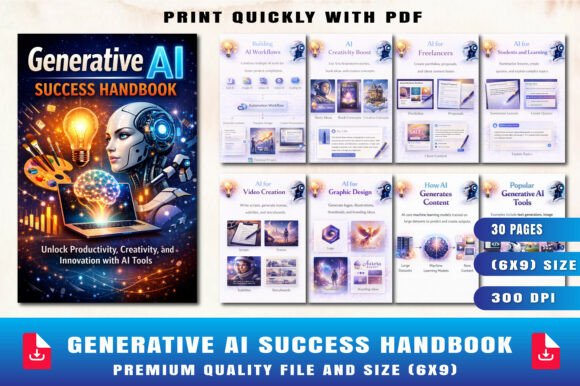
Imagine having a design assistant that never sleeps, instantly generates hundreds of visual concepts, and helps you refine every detail with precision. That is the promise of generative AI, and the Generative AI Success Handbook is your practical roadmap to harnessing this power for real creative projects. Whether you are a seasoned graphic designer expanding your toolkit or a business owner looking to elevate your brand visuals, this 30-page guide delivers clear, actionable insights that bridge the gap between AI capabilities and professional design output.
Why Generative AI Belongs in Your Design Workflow
Modern visual communication demands speed, consistency, and originality. Generative AI tools can produce logo variations, social media templates, color palette explorations, and even complete editorial layouts in minutes rather than days. The handbook demystifies how these models work under the hood, giving you the confidence to integrate them into your creative process without sacrificing quality or artistic control. By understanding prompt engineering, output refinement, and ethical considerations, you gain a competitive edge in everything from branding projects to UX design.
Practical Applications for Every Design Discipline
The handbook breaks down real-world uses across the design spectrum, making it easy to apply AI techniques directly to your current work:
- Branding and logo design – Generate multiple logo concepts based on mood boards, typography preferences, and brand personality traits
- Marketing materials – Create cohesive brochure layouts, flyers, and ad creatives that align with your brand identity
- Social media graphics – Rapidly produce platform-optimized visuals with consistent color palettes and visual hierarchy
- Website and UI design – Explore wireframes, hero sections, and component variations that improve user experience
- Editorial layouts – Develop magazine spreads and publication designs with balanced composition and typographic harmony
- Packaging design – Experiment with structural mockups, label concepts, and shelf-impact studies
- Advertising campaigns – Build campaign assets that maintain visual consistency across print and digital channels
- Presentations – Design professional slide decks with clean layouts and engaging imagery
- Merchandise and digital products – Generate patterns, apparel graphics, and product mockups for e-commerce
Smart Prompt Writing for Better Outputs
One of the most valuable sections of the handbook focuses on prompt crafting. Instead of vague requests, you learn to specify design parameters such as color temperature, typographic style, composition rules, and intended emotional tone. For example, rather than asking for a “modern logo,” you define the visual hierarchy, the ratio of negative space, and the exact Pantone references you want to explore. This precision reduces iteration time and produces results that feel intentionally designed rather than randomly generated.
Integrating AI with Classic Design Principles
Great design has always relied on fundamentals: typography, color theory, balance, rhythm, and contrast. The Generative AI Success Handbook shows how to apply these principles when working with AI tools. You will discover how to use AI to test readability across font pairings, evaluate color accessibility for brand identity systems, and maintain visual hierarchy even when generating complex layouts. The guide includes simple exercises that reinforce these concepts, so you build real skills rather than just theoretical knowledge.
Typography and Readability
Typography choices make or break a design. The handbook explains how to brief AI tools on type classifications, legibility requirements for different media, and the emotional impact of serif versus sans-serif families. Whether you are designing for print or digital, you learn to generate type-driven compositions that communicate clearly and look polished.
Color Palettes and Consistency
Color is one of the most powerful tools in a designer’s arsenal. The guide walks you through using AI to explore harmonious color schemes, test contrast ratios for accessibility, and generate palette variations that support your existing brand system. You also learn how to maintain color consistency across different materials, from packaging to social media assets.
Building a Cohesive Brand System with AI
A strong brand identity relies on consistency across every touchpoint. The handbook provides a framework for using generative AI to develop brand guidelines, create scalable assets, and produce mockups that demonstrate how the system works in real contexts. You learn to evaluate AI-generated assets for scalability, readability at different sizes, and alignment with brand personality. This ensures that every logo variation, color palette, and typographic treatment feels like part of a unified whole.
Evaluating and Refining AI Outputs
Not every AI-generated asset is production-ready. The handbook teaches you to critique outputs with a designer’s eye, checking for composition balance, visual hierarchy, white space usage, and audience appropriateness. You develop a workflow that treats AI as a brilliant collaborator rather than a replacement, always applying your own judgment to elevate the final result.
Ethical AI Usage and Future Opportunities
As AI tools become more powerful, ethical considerations matter more than ever. The handbook addresses copyright questions, originality concerns, and responsible usage practices that protect both your work and your clients’ brands. You also gain a forward-looking perspective on emerging trends in generative design, helping you stay ahead in a rapidly evolving field.
Quality creative assets have always been the foundation of effective visual communication. The Generative AI Success Handbook equips you with the knowledge and practical techniques to produce designs that are not only faster to create but also more thoughtful, consistent, and impactful. Whether you are refining a brand identity, building a campaign, or exploring new creative directions, this guide helps you turn AI into a genuine creative partner that amplifies your expertise rather than diluting it.