Cognitive Distortions Worksheets: Rewire Negative Thinking Patterns
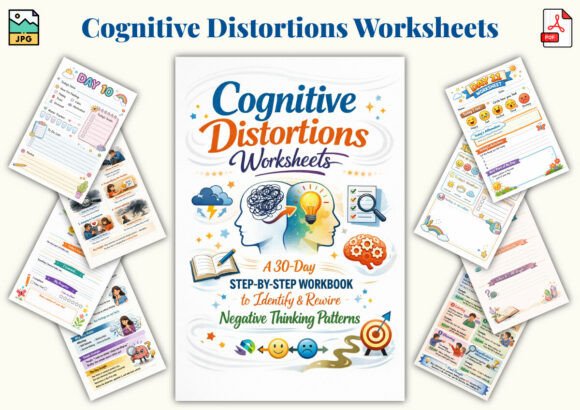
You sit down to start your workday, but your mind is already spinning. A single email from a colleague sends you into a spiral: “They think I’m incompetent. I’m going to get fired. I always mess things up.” Hours later, you’ve barely accomplished anything, and the self-doubt has drained your energy. This cycle of overthinking, catastrophizing, and negative self-talk isn’t just uncomfortable—it actively holds you back. The good news is that these patterns can be unlearned. The Cognitive Distortions Worksheets are a practical, 28-page step-by-step workbook designed to help you identify and rewire those automatic negative thoughts. It doesn’t promise instant happiness; instead, it gives you a repeatable process to regain control over your thinking.
Thoughts shape emotions, emotions drive actions, and actions determine the quality of your life. When your thinking is distorted, every decision feels heavier. This workbook offers a structured method to move from awareness, to understanding, to genuine transformation. It walks you through the 12 most common cognitive distortions—like all-or-nothing thinking, mental filtering, and personalization—using clear explanations and daily exercises. No fluff, no vague advice. Just concrete steps you can apply immediately.
Understanding the Twelve Distortions That Steal Your Clarity
Before you can change a pattern, you need to name it. The workbook begins by unpacking each of the 12 cognitive distortions with relatable examples. For instance, catastrophizing might show up as assuming a minor mistake will ruin your entire project. Overgeneralization turns one setback into a belief that you always fail. By reading through the descriptions and seeing your own experiences reflected, you start to realize these thought patterns are not facts—they are habits your brain has learned.
This first phase of identification is where many people feel a sense of relief. You are not broken; your mind is simply running a familiar script. The worksheets help you label each distortion as it arises, which immediately reduces its power. In the heat of the moment, you can ask yourself: “Is this catastrophic thinking or am I looking at the evidence?” That split second of awareness is the seed of change.
A Proven Five-Step Method to Challenge and Replace Irrational Thoughts
The core of the workbook is a five-step rewiring method that works like a mental audit. Each step is presented on a dedicated worksheet so you can practice it repeatedly until it becomes automatic. The steps are:
- Identify the triggering thought and the situation.
- Examine the evidence for and against the thought.
- Challenge the distortion by asking objective questions.
- Reframe with a balanced, realistic alternative.
- Track the emotional shift to reinforce the new pattern.
Imagine you are preparing a presentation and think, “If I don’t nail this, everyone will think I’m a fraud.” Using the worksheet, you would list actual evidence: you have prepared thoroughly, you’ve given similar talks before, and feedback has been positive. Then you reframe: “I will do my best, and even if it’s not perfect, that doesn’t define my worth.” Over time, this practice weakens the old neural pathways while strengthening healthier responses. For professionals and entrepreneurs who face high-stakes decisions daily, this method is especially valuable—it saves mental energy and prevents decision paralysis.
Practical Benefits for Work, Creativity, and Relationships
The value of this workbook extends far beyond feeling good. Clearer thinking leads to tangible outcomes in your career and personal life. When you are no longer trapped in loops of self-doubt, you can focus your creative energy on solving problems instead of managing anxiety. A marketer who constantly second-guesses campaign ideas will find it easier to test and iterate. A freelancer who struggles with imposter syndrome can complete projects faster without endless revisions. Even communication improves: when you stop assuming the worst about a partner’s or colleague’s intentions, you respond more thoughtfully.
The workbook also includes behavioral experiment exercises that encourage you to test your fears in real life. For example, if you believe that asking for help makes you look weak, you design a small experiment—ask for input on a task and observe the actual response. This evidence-based approach helps dismantle distortions that talk therapy alone might leave untouched. The weekly reflection pages allow you to track emotional progress over time, so you see patterns and measure your growth.
Who Benefits Most from This Structured Approach
Adults between 20 and 50—especially professionals, creators, entrepreneurs, and educators—often face pressure that fuels distorted thinking. Performance reviews, deadlines, client feedback, and social comparison are fertile ground for cognitive distortions. If you are a blogger or small business owner, you might struggle with perfectionism or fear of criticism, making it hard to publish content or launch new offers. This workbook is tailored for people who want a self-directed, systematic way to address those obstacles without needing a therapist (though it is an excellent complement to therapy).
The design is deliberately simple: 6×9 inch pages with generous writing space, suitable for printing or digital journaling. The minimal layout keeps distractions low, so you can focus on the work. It is not a quick fix—most users see meaningful shifts after consistent use over a few weeks. The 30-day progress review at the end helps cement gains and plan for continued practice.
That said, this workbook has limitations. It is not a substitute for clinical treatment if you are experiencing severe depression, anxiety disorders, or trauma. For those cases, professional guidance is essential. Also, some users may find a few worksheets too structured for their taste; if you prefer free-form journaling, you might adapt the prompts to feel less rigid. Comparing it with other cognitive behavioral therapy (CBT) resources reveals that this workbook’s strength is its sequential, step-by-step format—it holds your hand through the process rather than assuming prior knowledge. That makes it ideal for beginners or for anyone who wants a concrete plan to follow.
Practical Tips for Using the Worksheets Effectively
To get the most out of the Cognitive Distortions Worksheets, set aside 10–15 minutes daily. Consistency matters more than duration. Start with the distortion that resonates most with your current struggles—perhaps catastrophizing or mind reading. Use the daily worksheets to capture one or two automatic thoughts each day. Then, rely on the weekly reflection pages to review what patterns repeat and what situations trigger them.
Consider pairing the workbook with a simple habit: before you check email or social media, run a quick mental scan for distortions that might arise. Over time, this proactive awareness prevents spirals before they gain momentum. You can also share insights with a trusted colleague or friend, creating an accountability loop that reinforces the new thinking habits.
One thoughtful observation: many people initially feel resistance to challenging their own thoughts. The brain often mistakes familiar pain for safety. The worksheets are designed to meet that resistance with compassion—there are specific self-compassion reframing tools that help you soften the inner critic. For example, instead of berating yourself for an unhelpful thought, you learn to say, “That’s a common pattern. What can I tell myself that is both true and kind?” That shift alone can reduce the emotional charge and make the rest of the process easier.
Transforming the Way You Think and Feel
The ultimate goal of the workbook is not to eliminate all negative thoughts—that would be unrealistic. Instead, it helps you become fluent in recognizing distortions and responding with flexibility. You gain back the mental bandwidth that was once consumed by worry and rumination. For an entrepreneur deciding whether to pivot their business strategy, or a creator doubting their next piece of content, that clarity is priceless. The worksheets give you a repeatable framework to handle setbacks without spiraling, and to approach opportunities without the weight of unnecessary fear.
If you have ever felt stuck in a loop of overthinking or self-doubt, this workbook offers a way out that is both practical and grounded in proven psychology. It empowers you to stop being a passenger in your own mind and start steering with intention. Whether you use it as a standalone tool or alongside other self-improvement practices, the Cognitive Distortions Worksheets provide the structure to rewire negative thinking patterns—one thought at a time.