1000 Anxiety Relief Prompts: A Practical Guide to Calming Your Mind and Building Daily Peace
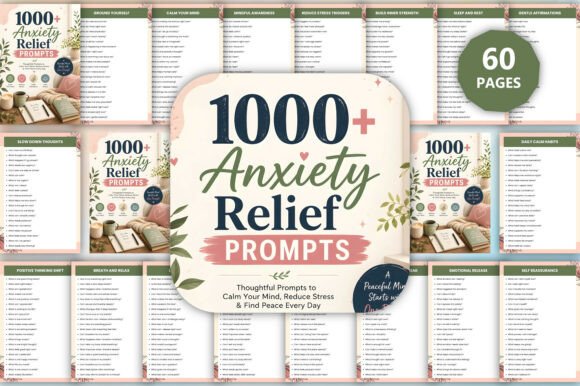
If you have ever felt stuck in a loop of anxious thoughts, you know how exhausting it can be to simply slow down. 1000 Anxiety Relief Prompts offers a structured yet gentle way to step out of that loop. This collection of guided prompts is designed to help you relax your mind, reduce stress, and find inner peace through consistent, small practices. But like any tool, its effectiveness depends on how you use it. Many people pick up a resource like this and then wonder why they do not see lasting change. The reason is rarely the prompts themselves. It is usually how they are approached.
This article walks through common mistakes people make when using prompt collections for anxiety, what those mistakes cost you in terms of time and relief, and how to get the real value out of the 1000 prompts. Whether you are a busy professional, a freelancer juggling multiple projects, or someone simply looking for more calm in your day, the right approach makes all the difference.
Mistake 1: Treating the Prompts Like a One-Time Read
The biggest misunderstanding about 1000 Anxiety Relief Prompts is thinking you can read through them once and feel better. Anxiety is not a fact you can memorize away. It is a pattern of thinking and feeling that needs ongoing attention. If you flip through the entire collection in one sitting, you will likely feel a temporary sense of relief from the novelty, but that relief fades quickly.
What happens instead: You miss the deeper work. Each prompt in this collection is meant to be sat with. The Overthinking Thought Control section, for example, asks you to identify an anxious thought and observe it without judgment. If you rush past it, you never train your brain to actually do that in real time. You end up with knowledge about the exercise but no practiced skill.
A better approach: Pick one prompt per day. Write it down in a notebook or type it into a notes app. Spend three minutes with it. That is all. Consistency over quantity is what builds mental clarity. The 1000 prompts are designed to last you years, not hours. When you stretch them out, each one becomes a small anchor in your day rather than a passing sentence.
Mistake 2: Sticking Only to Prompts That Feel Comfortable
It is natural to gravitate toward the prompts that feel soothing. The Positive Thinking Gentle Affirmations section is easy to digest, and it feels good. But anxiety is often rooted in avoidance. If you only engage with the parts of the collection that confirm what you already believe or feel, you miss the sections that challenge your patterns.
What happens instead: You reinforce a limited emotional range. The Grounding Present Awareness prompts might feel uncomfortable if you are used to living in your head. The Emotional Support Self-Comfort prompts might make you cry. That discomfort is not a sign that the prompt is wrong for you. It is a sign that you are touching something important.
A better approach: Rotate through the different categories intentionally. Try one prompt from the Breathing Relaxation Prompts section even if you think breathing exercises are too simple. Try a grounding prompt when you feel safe, not just when you feel panicked. The variety in 1000 Anxiety Relief Prompts exists because anxiety shows up in different forms. Meeting it across all those forms is how you build resilience.
Mistake 3: Using Prompts Only During a Crisis
Many people reach for anxiety tools only when they are already overwhelmed. By that point, your nervous system is already in high alert mode, and it takes much more effort to calm down. Using prompts reactively rather than preventively is one of the most common reasons people feel like "nothing works."
What happens instead: You are asking your brain to shift from panic to peace in a matter of seconds. That is not how the nervous system works. The Daily Calm Habits Routine section exists precisely to help you practice calm when you do not need it, so that calm becomes more accessible when you do.
A better approach: Use the prompts as a morning or evening ritual. Set a timer for five minutes after you wake up or before you go to sleep. Pick a prompt from the Daily Calm Habits or Grounding Present Awareness section and simply follow it. Over time, your brain learns that calm is available at any point in the day, not just when you have hit a breaking point. This preventive practice is what reduces the frequency and intensity of anxiety episodes.
Mistake 4: Overlooking the Breathing and Grounding Sections
There is a tendency to skip over prompts that seem too simple. Breathing exercises, in particular, are often dismissed because they feel basic. But the Breathing Relaxation Prompts in this collection are not just about taking deep breaths. They are structured to shift your autonomic nervous system from sympathetic (fight-or-flight) to parasympathetic (rest-and-digest). That shift is physiological, not psychological.
What happens instead: You stay in your head, trying to think your way out of anxiety. Anxiety is not purely a cognitive problem. It lives in your body. If you skip the somatic prompts, you are addressing only half the issue. The Grounding Present Awareness prompts are designed to bring you back into your body and your environment, which interrupts the cycle of overthinking at a biological level.
A better approach: When you feel stuck mentally, choose a physical prompt intentionally. Put your hand on your chest and follow the breathing guidance. Name three objects in the room. Feel your feet on the floor. These are not distractions. They are direct interventions. By including them in your regular rotation, you give yourself a complete toolkit instead of just a mental one.
Mistake 5: Expecting Perfection or Immediate Results
Anxiety relief is a process, not an event. A common source of frustration is expecting that after a few prompts, you will feel permanently different. When that does not happen, people conclude the resource is not effective and move on to the next thing. This pattern of switching tools without committing to any of them is one of the biggest obstacles to real progress.
What happens instead: You never give any single method enough time to work. The Emotional Support Self-Comfort prompts are built around self-compassion, which is a skill that develops slowly. If you do not give yourself permission to be imperfect while using the prompts, you recreate the same pressure that fuels your anxiety in the first place.
A better approach: Give yourself a low bar. After using a prompt, ask yourself not "Did this fix everything?" but "Did this shift anything, even slightly?" A small shift is a win. A moment of stillness is a win. Noticing your breath for ten seconds is a win. Over weeks and months, those small shifts accumulate into a calmer baseline. The 1000 Anxiety Relief Prompts are designed for that kind of gradual, sustainable change.
What to Check Before You Use the Collection
Before you start, take a moment to think about your goals. Are you looking for daily structure? A way to process difficult emotions? A tool for grounding during high-stress moments? The collection covers all of these areas, so knowing what you need helps you navigate it better.
Check the file format and make sure it works for your preferred device. The product includes an editable Canva link, which means you can customize prompts or even create your own journal pages from them. That is a nice feature if you like to adapt materials to your personal style. If you prefer a simpler approach, the high-quality upload-ready files work well for printing or viewing directly.
Also consider your current habits. If you do not already have a routine for self-reflection, start with just one prompt a day at a consistent time. Attach it to an existing habit, like having coffee in the morning or brushing your teeth at night. That makes it far more likely to stick than trying to carve out a whole new time slot.
Building a Calmer Daily Mindset
What makes 1000 Anxiety Relief Prompts different from a typical journal or affirmation book is its structure across multiple areas of well-being. It does not rely on one method. It gives you breathing exercises, grounding tasks, thought control practices, emotional comfort prompts, and daily habit builders. That variety means you can match the prompt to the moment rather than forcing the moment to fit the prompt.
Over time, using the prompts consistently trains your attention. You become more aware of when anxiety is building before it fully arrives. You learn which types of prompts work best for different situations. You build a personal library of strategies that are not abstract concepts but practiced responses.
The goal is not to eliminate anxiety entirely. That is an unrealistic expectation for most people, and pursuing it often creates more stress. The goal is to relate to your anxiety differently. To see it clearly, respond with intention, and not let it run the show. That is what a sustained practice with these prompts can offer.
If you approach the collection with patience, use it preventively, rotate through the sections, and give yourself grace when progress feels slow, you will get more out of it than you might expect. The prompts are tools. The real change happens in how you use them.