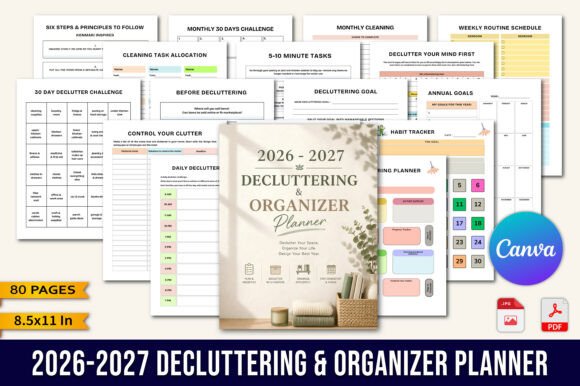
The 26–2027 Decluttering Organizer Planner: Reclaim Your Space and Focus for the Year Ahead
If you have ever stood in the middle of a room overwhelmed by the sheer volume of things around you, you already understand that clutter is not just a physical problem. It is a mental weight, a quiet drain on your energy and attention. The 26–2027 Decluttering Organizer Planner is not simply another notebook with dates printed inside. It is a structured companion for anyone ready to move from feeling scattered to feeling in control. As we look at the next two years, the need for clear, practical systems to manage our homes, schedules, and minds has never been more relevant.
Why Decluttering Matters More Now Than Ever
We live in an era of constant input. Notifications, commitments, physical goods, digital files, and social expectations all compete for our attention. The idea of simplifying has shifted from a niche lifestyle choice to a near-universal aspiration. People are realizing that living with less friction—fewer objects to clean around, fewer tasks to track independently, fewer mental loose ends—creates genuine room for what matters. The 26–2027 Decluttering Organizer Planner arrives at a moment when many are reevaluating how they spend their time and energy. Remote and hybrid work have blurred the lines between professional and personal spaces. Homes now serve as offices, gyms, schools, and sanctuaries all at once. Without intentional organization, those spaces can quickly become sources of stress rather than rest.
This planner directly addresses that tension. It does not promise a perfect, Instagram-ready home overnight. Instead, it provides the scaffolding to build sustainable habits. The two-year calendar from 2026 to 2027 allows you to see the big picture while the daily, weekly, and monthly layouts help you break down actions into manageable steps. That dual perspective—seeing both the horizon and the next footstep—is what makes consistent progress possible.
A Planner Designed for Real Life, Not Just Good Intentions
Many planning tools start strong but fail because they assume you will remember to use them. The 26–2027 Decluttering Organizer Planner anticipates that you need prompts, not just empty pages. The inclusion of a welcome page and a personal identification section, such as "This Book Belongs To," creates a sense of ownership. When you write your name inside, you are making a small commitment to yourself. From there, the planner unfolds in a logical sequence that mirrors how real decluttering works.
You do not begin by throwing everything into boxes. You begin by looking at your environment and your mindset. The section titled "Declutter Your Mind First" is particularly valuable. Before you touch a single drawer, the planner encourages you to identify what is weighing on you mentally. This is not fluff. Psychological research has consistently shown that mental clutter—unresolved decisions, lingering worries, unfiled thoughts—makes physical decluttering harder. By addressing your internal landscape first, you set yourself up for more decisive action in your external space.
From there, the planner guides you through goal-setting. The "Decluttering Goal No. 01 to 10" pages allow you to name specific outcomes, whether that is clearing your bedroom closet, organizing your home office, or reducing your kitchen counter to only essential tools. Each goal becomes a target, not a vague wish. The "Six Steps Principles To Follow" section offers a repeatable framework that you can apply to any room or category of belongings. This is where the planner moves from inspiration to instruction.
Structured Challenges That Build Momentum
One of the most engaging aspects of this planner is its range of decluttering challenges. The 7-Day Declutter Challenge is perfect for someone who feels stuck and needs a quick win. Seven days is short enough to commit to without dread, but long enough to create noticeable change. The 100 Items Declutter Challenge takes a different approach. Instead of focusing on time, it focuses on volume. Counting items as you let them go creates a tangible sense of progress. Each number brings you closer to a lighter home.
For those who prefer a deeper reset, the 30-Day Declutter Challenge provides a full month of guided action. This is not a generic list of tasks. The planner includes specific checklists for different areas of the home—Bedroom Checklist, Living Area Checklist, Office Checklist—so you never have to guess what to tackle next. These lists are grounded in practical observation. A bedroom checklist, for instance, might include clearing nightstands, organizing dresser drawers, and evaluating linens. An office checklist will address paperwork, cables, supplies, and digital files. By breaking down each room into discrete actions, the planner eliminates the paralysis that often comes from looking at a whole room and not knowing where to start.
Daily, Weekly, and Monthly Planning for Lasting Change
Decluttering is not a one-time event. It is a practice. The Daily Planner and Weekly Planner sections are designed to be flexible enough for busy schedules while still providing structure. You can use the daily pages to list three small tasks that will take fifteen minutes or less. The "5-10 Minute Tasks" section is especially useful for days when you have limited energy or time. Short bursts of activity, repeated consistently, often achieve more than occasional marathon cleaning sessions.
The Weekly Routine Schedule and Monthly Cleaning pages help you distribute chores across the week and month so that nothing is forgotten. Cleaning task allocation sheets allow families or roommates to share responsibilities fairly. This is where the planner becomes a tool for collaboration, not just individual organization. The Family Chore Sheet and Cleaning Task Allocation sections reduce friction in shared spaces by making expectations visible. When everyone knows what they are responsible for, resentment decreases and accountability increases.
The Habit Tracker is another feature that supports long-term change. Whether you are tracking daily bed-making, weekly closet purges, or monthly deep cleans, seeing your streak of checked boxes builds motivation. The Day Broken Down layout allows you to plan your time in more detail, which is helpful for professionals and creators who juggle multiple roles.
Practical Implications for Professionals, Creators, and Entrepreneurs
For professionals working from home, the boundary between workspace and living space is often porous. A cluttered desk can lead to a cluttered mind, which directly impacts productivity. The Office Checklist and Purging Plan sections are particularly relevant for anyone who needs their work environment to support focus rather than distract from it. Entrepreneurs and freelancers, who often manage their own schedules, will find the Goal Planner and Annual Goals pages useful for aligning their physical environment with their business objectives. A clean, organized workspace signals to clients and to yourself that you take your work seriously.
Creators—writers, artists, designers, marketers—know that creative work requires mental space. The Declutter Your Mind First exercise is directly applicable here. By clearing mental clutter before sitting down to create, you reduce resistance and increase flow. The planner also includes generous Notes pages for capturing ideas, reflections, and observations as you go through the decluttering process. These pages become a personal record of your journey, which can be encouraging to look back on later.
How the Planner Fits into Current Lifestyle Trends
The rise of minimalism, slow living, and intentional consumption has shifted how people think about their possessions. Instead of accumulating more, many are asking: What do I actually need? What adds value to my life? The 26–2027 Decluttering Organizer Planner aligns with this mindset by encouraging thoughtful evaluation before action. The "Before Decluttering" page prompts you to consider your motivations and desired outcomes. The "Control Your Clutter" section helps you identify patterns that lead to accumulation, so you can address root causes rather than just symptoms.
Sustainability is another factor driving interest in decluttering. When people organize their homes, they become more aware of what they own and what they waste. The planner's Home Maintenance pages encourage regular care of belongings, which extends their life and reduces the need for constant replacement. This practical approach to sustainability resonates with readers who want to live more lightly on the planet without adopting a rigid ideology.
Making the Most of the Planner: A Few Observations
Based on how structured planners tend to work best, here are some observations for using this tool effectively. Start with the "Declutter Your Mind First" exercise before filling out any other page. Spend ten to fifteen minutes writing down what feels overwhelming. Then, choose one challenge that matches your current capacity. If you are new to decluttering, the 7-Day Declutter Challenge is an excellent entry point. If you have some experience and want a more substantial reset, the 30-Day Declutter Challenge will take you deeper.
Use the Weekly Routine Schedule to assign recurring tasks to specific days. For example, Monday could be for sorting mail and paperwork, Wednesday for tidying the living area, and Friday for a quick bathroom refresh. This prevents any single day from feeling overloaded. The 5-10 Minute Tasks section is ideal for the in-between moments in your day—while waiting for coffee to brew, during a work break, or before bed. Small actions compound into significant results over weeks and months.
The Rearranging and Purging Plan pages encourage you to think beyond just removing items. Sometimes, simply rearranging furniture or storage can make a space feel completely new without discarding anything. The purging plan, on the other hand, helps you schedule regular reviews of your belongings so that clutter does not creep back unnoticed.
Final Thoughts on a Tool for Intentional Living
The 26–2027 Decluttering Organizer Planner is more than a schedule or a to-do list. It is a framework for living with greater intention over the next two years. By combining daily, weekly, and monthly planning with targeted decluttering challenges and reflective exercises, it addresses both the practical and psychological dimensions of organization. For anyone who feels that their environment does not fully support how they want to live and work, this planner offers a clear, actionable path forward. The pages are designed to be used, not just admired. And that is exactly what meaningful change requires.