AI Prompt Productivity Workbook: Building Smarter Conversations with Your AI Assistant
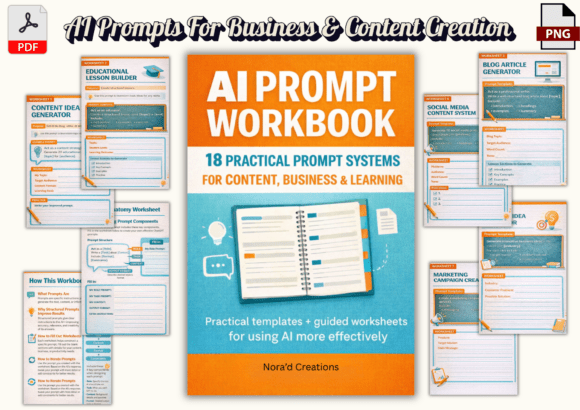
There is a quiet shift happening in how people work with artificial intelligence. Anyone who has spent time chatting with ChatGPT, Claude, Gemini, or similar assistants knows the feeling of getting a generic answer when you wanted something sharper. The difference between a vague response and something genuinely useful often comes down to how you phrase your request. This is where the AI Prompt Productivity Workbook enters the picture. It is a 22-page digital workbook designed to help you move from hoping for good results to consistently getting them.
What the workbook actually does
The workbook is not a theoretical guide filled with abstract concepts. It gives you 18 structured prompt worksheets, a prompt anatomy training section, an experimentation lab, and a personal workflow builder. You work through these pages with your AI tool of choice, practicing as you go. The format is print ready at 6 x 9 inches, and you get both PDF and PNG versions. Whether you use it on a tablet or print it out, the structure stays the same.
The core idea is simple: you learn by doing. Instead of reading about prompt engineering, you fill out worksheets that ask you to write prompts, evaluate responses, and refine your approach. Over time, you build your own prompt library and workflow system that fits how you actually work.
For creators wrestling with writer's block
Consider a freelance writer who needs to produce weekly newsletter content. Sitting down to a blank page every Monday morning can drain energy before the first sentence lands. With the workbook, that writer can develop a set of prompts that generate outlines, headline variations, and opening paragraphs aligned with their voice. The workbook frameworks help structure requests so the AI understands tone, audience, and format. After a few sessions, the writer has a library of reliable prompts that cut the prep time in half.
One writer I know described her first week with the workbook as unexpectedly freeing. She had been using AI for months but always felt like she was guessing. The worksheets gave her a reason to slow down and think about what she actually needed from the tool. Her prompts became shorter and more precise. The AI started delivering material that felt closer to her own style.
For entrepreneurs building systems
Small business owners and solopreneurs often wear too many hats. One day you are drafting customer emails, the next you are brainstorming product descriptions, and somewhere in between you need to outline a social media plan. The workbook helps you create a consistent approach for each task. You can build separate prompt sets for customer support responses, marketing copy, and strategic thinking.
An entrepreneur running an online store might use the workbook to design prompts that generate product descriptions with a specific tone and keyword structure. Instead of typing the same instructions every time, they save their best prompts and reuse them with minor adjustments. The workflow builder section lets them map out how prompts connect to each other, creating a system that feels less like starting from scratch each time.
The practical benefit here is speed. When you have a reliable prompt system, you spend less time explaining what you want and more time refining what the AI gives you.
For educators and trainers
Teachers, course creators, and workshop facilitators face a different challenge. They need AI to produce material that is accurate, age appropriate, and aligned with learning goals. The workbook helps them think through each layer of a prompt before they send it to the AI. The anatomy training section breaks down what makes a prompt work, covering elements like context, constraints, and desired output format.
A curriculum developer might use the worksheets to create prompts that generate quiz questions, discussion prompts, or simplified explanations of complex topics. Over weeks of practice, they build a set of proven prompts that save hours of manual content creation. The experimentation lab becomes a safe space to test prompts before using them with actual students.
For professionals managing information overload
Anyone who works with dense reports, lengthy emails, or research papers knows how exhausting it can be to extract the important parts. The workbook encourages users to design prompts that summarize, compare, or extract specific data points from large texts. Instead of scrolling through pages of content, you let the AI do the heavy lifting while you focus on decisions.
A marketing analyst might use the workbook to create a prompt that pulls competitor insights from industry reports. A project manager could build a prompt that summarizes weekly status updates from a team. The key is that these prompts are not one-time creations. You save them, test them, and improve them as your needs change.
How the worksheets actually work
Each of the 18 structured prompt worksheets targets a different scenario. Some focus on clarity, others on creativity, and a few on troubleshooting weak responses. You start by writing a prompt, then the worksheet asks you to reflect on the output. What worked? What was missing? How could you phrase the request differently?
This reflective loop is where the learning happens. You begin to notice patterns in how the AI responds to certain words or sentence structures. Over time, you develop an instinct for what makes a prompt effective. The workbook captures that learning so you can return to it later.
The prompt anatomy training section is particularly useful if you have ever felt unsure about why a prompt failed. It breaks prompts into components like instruction, context, examples, and output format. Understanding these pieces helps you diagnose problems without guessing.
The personal AI workflow builder is the final piece. It asks you to map out how you use AI in your daily life or work. You identify recurring tasks, design prompts for each one, and connect them into a system. This turns scattered interactions into a deliberate process.
Strengths worth noting
The workbook's biggest strength is its hands-on structure. You are not just reading about prompts; you are writing them and evaluating the results. The 22-page length is manageable for people who want to see progress without committing to a lengthy course. The print ready format means you can work offline, which is helpful if you prefer to think on paper before typing.
Another strength is the focus on building your own library. Many AI guides give you generic prompts that work for a narrow set of tasks. This workbook pushes you to create prompts that reflect your actual needs. The result is a collection of tools that feel personal and relevant.
Limitations to consider
The workbook works best for people who are ready to invest a few hours into the process. If you are looking for a quick list of copy paste prompts this is not that resource. It requires you to think, write, and iterate. The value comes from the effort you put in.
Also, the workbook is tool agnostic. It does not teach you how to use ChatGPT or Claude specifically. It focuses on the prompt writing skill that works across platforms. If you are brand new to AI assistants, you might need a few weeks of basic use before the workbook feels natural.
The experimentation lab is a great concept, but some users may wish it included more guided exercises. If you thrive on structured examples, you might find yourself creating your own experiments alongside the provided worksheets.
Before you dive in
Think about the tasks where AI currently frustrates you. Maybe it is generating marketing copy that sounds too generic. Maybe it is summarizing meetings in a way that misses the nuance. The workbook is most useful when you come with specific pain points. Fill out the worksheets with real problems, not hypothetical ones.
Keep a digital folder where you save your best prompts. Over weeks and months, that folder becomes a personal resource that saves you time and mental energy. The workbook gives you the structure to build that folder intentionally.
The AI Prompt Productivity Workbook is not a magic fix. It is a practical tool for anyone who wants to stop wrestling with AI and start getting consistent, useful results. Whether you are a writer, entrepreneur, educator, or professional handling too much information, the worksheets give you a clear path forward. You bring the curiosity. The workbook brings the structure.